Thursday, 16 September 2021

Crypto Guide Part 1 - How to Create a Wallet to Store Cryptocurrency in Singapore

Blockchain technology took the world by storm a couple of years ago and the market for blockchain-related products have grown to more than a trillion dollars. Some people consider the market as pure speculation on nothingness while others consider the market as an opportunity in terms of investment or solving real world problems. Nevertheless, to navigate this space, one needs to acquire a minimal understanding of the market and the various entry points. In this series of blogpost on Crypto Guide, I will be explaining from a user perspective the steps that I have learnt and used to navigate the blockchain technology space. After this guide, I am sure that navigating the space is not as daunting as it may first appear to be, and a whole new world and community will be revealed to you.

[Part 1] Purchasing My First Cryptocurrency: Creating a Wallet

Before you can purchase your first cryptocurrency, there are several things you have to do. First, you need a wallet to store your cryptocurrency and to make transactions. This step is optional if you just intend to trade cryptocurrency in an exchange. However, if you wish to explore the world of blockchain technology, it is imperative that you acquire a wallet.

There are two kinds of wallet: a hot wallet and a cold wallet. A hot wallet is a digital wallet that stores your crypto on the internet. A cold wallet is a physical wallet that you store outside of the internet. There are pros and cons to having a cold or a hot wallet. Personally, I trust the security of the exchanges and wallets that I use, thus I am comfortable with just using a hot wallet.

Cold Wallet

1. Less prone to hacking as the crypto is stored offline.

2. Not always supports the different blockchains.

3. If you lose the physical wallet, you lose the crypto. If you lose your keys to your physical wallet, you lose the crypto.

Hot Wallet

2. More prone to hacking.

2. Able to download various kinds of wallets that support different kinds of blockchains.

3. You only lose the crypto if you lose your keys.

Thus, the most defining aspect between the two is the security of your crypto. Another thing that I should clarify are the keys. Keys allow you to access your crypto from several different devices or even salvage a crypto wallet when you accidentally delete the wallet in your device. A key can be in the form of a password, OTP verification, thumbprint verification, or a seed phrase and this varies from wallet to wallet.

Example of a Seed Phrase. Credits: Wikipedia

The most important key for any wallet is the Seed Phrase. When you create a new wallet, hot or cold, you are given a Seed Phrase which is usually a 24 word list. Write this important Seed Phrase in two notebooks and store it somewhere safe. Do not store and type the Seed Phrase in your computer because someone can hack and steal it. Giving someone this Seed Phrase is essentially giving that person your entire wallet. There is an important saying in the crypto space which is: "Not your keys, not your crypto." I have been around in several Discord chats and people have lost their Seed Phrases and essentially their entire crypto savings when they lose their seed phrase.

Seed Phrases are also useful if you intend to use several device to access you crypto wallet. After installing the wallet in a new device, the wallet app or extension will prompt you to enter your Seed Phrase. Thus, you can simply enter your 24 words and your crypto wallet will be made available to you.

The great thing about seed phrases and the security of wallets is that someone stealing your device with your crypto wallet already installed in it do not immediately have access to your crypto wallet. For hot wallets, your crypto is stored on the blockchain itself which cannot be physically stolen. The person will either need to steal your password to the hot wallet or steal your Seed Phrase. Thus, the important number one rule: Not your keys, not your crypto.

Which Wallet Should I Use?

From here on forth, I will be speaking solely on experience. I chose to only use a hot wallet due to the efficiency of hot wallets and my belief in the security of the wallet and exchanges that I use. There are several different kinds of hot wallets in the market. It is free for you to install these wallets and usually, hot wallets simply charge a percentage fee for making transactions using their wallets.

The type of hot wallet that you need depends on the cryptocurrency that you intend to purchase or make transactions with. You have to think of blockchain technology as a network, like the internet. There is Ethereum and Bitcoin, the current two most popular cryptocurrency. They operate on two different networks. That means that if you have a wallet that supports the Ethereum network only, you would not be able to store and transact Bitcoins in that wallet.

Thankfully blockchain technology and wallet creators have developed features which allows you to transfer cryptocurrencies between blockchains. For example, you may find an application that was developed on the Ethereum network that accepts Bitcoin payment. How? Bitcoin can be wrapped in an Ethereum-compatible layer and transacted using a side chain on the Ethereum network. There are different strategies that wallet and apps use to enable cross-functionality between different blockchains, but the important thing to note is that it is possible.

Metamask wallet icon.

The most useful and widely used wallet that you most definitely must have is a Metamask wallet. You will find that almost all applications and exchanges accepts this wallet and may even be a requirement to use a lot of dapps. If this is your first time, you need to sign up for a metamask wallet account in the Metamask website, metamask.io, and follow the steps to set up an account. A Seed Phrase will be given to you, and this is the part where you write it down in a notebook.

If you are using a computer, you must get a metamask extension and bookmark it. I use Chrome and the extension will appear on the top right hand corner of the browser after you have bookmarked it. If you need to access it, you can simply click on the Metamask icon which is a picture of a fox, and enter your password. If you are using a phone, you have to download the metamask app. Making purchases or transactions through your phone is a little inconvenient as you may need to use the metamask app as a browser and this is not the most user-friendly.

There are also several other different wallets that are available but I would recommend you to only install the wallet that you need to use because the most common cryptocurrencies can already be transacted using your Metamask wallet. However, if there is an altcoin that is not supported by Metamask and/ or have its own wallet that carries more benefits for their users, then do go ahead and use it. One example is the Binance wallet that facilitate transactions on the Binance network. It is possible for you to create a Binance node in you Metamask wallet to support Binance transactions, however, if you are unfamiliar as to how to install a node, you can simply use the Binance wallet. Unfortunately, not all apps support the Binance wallet. For example, a popular blockchain game, mydefipet only allows players who have a metamask wallet with Binance nodes installed to play and does not support the Binance wallet. (Another example why Metamask is the most important wallet to have.)

In Singapore, there are currently no restrictions to downloading and installing hot or cold wallets such as Metamask or Ledger. Downloading Metamask is also free. Metamask only charges a very minimal sum which is almost negligible when you make transactions using their wallet.

Now that you know how to create a wallet, the next step is to create an account in a crypto exchange to buy some crypto. Do check out Crypto Guide Part 2 to find out how!

Crypto Guide 1: How to Create a Wallet to Store Cryptocurrency in Singapore

Crypto Guide 2: How to Purchase Cryptocurrency in a Crypto Exchange

Crypto Guide 3: How to Make a Transaction on the Ethereum Blockchain

Crypto Guide 4: How to Make a Transaction on an Ethereum Sidechain Network

Monday, 6 September 2021

Who Are the Sea Peoples? An Introduction.

Ruins. Picture by Sulliman Sallahi.

Somewhere around 1200BC, the world history changed. The great civilisations of the Bronze Age faced an unprecedented crises that eventually resulted in the destruction of the global economy and societies. The next few centuries were later came to be known as the world’s first known Dark Age for there were few records written during this time period. Gone were the scribal traditions, mega-polis, and global trade that had flourished during the Bronze Age.

There were many reasons that were proposed by scholars for the collapse. Internal rebellions (Zuckermann, 2007), “earthquake storms” (Stiros & Jones, 1996) (Nur & Cline, 2000), drought (Carpenter, 1966), famine (Kaniewski et al., 2010) (Drake, 2012) and cultural innovations such as the creation of a class of private merchants (Sherratt, 1998) and a military shift from chariotry to infantry warfare (Drew, 1993). But one of the more intriguing proposals for the change was the invasion of the Sea Peoples.

A depiction of the army of Ramesses III fighting the Sea Peoples.
Sourced from Wikimedia Commons.

The modern umbrella term ‘Sea Peoples’ was first coined by Maspero in 1881 based on de Rouge’s term ‘peuples de la mer’ (literally Peoples of the Sea) (de Rouge, 1867). de Rouge used the term to describe invaders of Egypt during Pharaoh Ramesses III’s reign portrayed on the Second Pylon reliefs at Medinet Habut. Three distinct events became the markers for identifying ‘Sea People’ groups within the Egyptian archives; the aforementioned attacks against Pharaoh Ramesses III in 1179 BC and 1176 BC and an earlier invasion of Egypt by the Libyan king Mertenye during Pharaoh Merneptah’s reign in around 1208 BC where he employed some Sea People groups as mercenaries (Drew, 1993: 54) (Woudhuizen, 2006: 43). From this distinction the nine Sea Peoples ethnonyms are Lukka, Sherden, Shekelesh, Teresh, Eqwesh, Denyan, Weshesh, Tjekker, and Peleset.

Sea Peoples Invasion 

The Great Karnak Inscription narrating Pharoah Merneptah's battle with the Sea Peoples.
Sourced from Wikimedia Commons.

The Sea Peoples involvement to the Late Bronze Age Collapse are inscribed in several primary written records namely from Egyptian, Ugaritic and Hittite sources (Adams & Cohen, 2013). On example is the inscription on the walls of the pharaoh Ramesses III’s mortuary temple at Medinet Habu, where it was written: “The foreign countries made a conspiracy in their islands. All at once the lands were removed and scattered in the fray. No land could stand before their arms, from Khatte, Qode, Carchemish, Arzawa, and Alashiya on, being cut off at [one time]. A camp [was set up] in one place in Amurru. They desolated its people, and its land was like that which has never come into being. They were coming forward towards Egypt, while the flames were prepared before them. Their confederation was the Peleset, Tjekker, Shekelesh, Danuna, and Weshesh, lands united. They laid their hands upon the lands as far as the circuit of the earth, their hearts confident and trusting.” (Wilson, 1969: 262 – 263). 

The Sea Peoples attacks were also found written in secondary sources, meaning written sources that were written hundreds of years after the incident. One example is Homer’s Odyssey which was composed around 750BC that mentioned about attacks by Achaeans on the Egyptian kingdom which were reminiscent of the attacks portrayed in the Egyptian sources.

Aegean Bichrome Pottery.
Picture from (Lindblom, Mommsen, & Whitbread,  2009).


While the textual evidences are few, the non-textual evidences for the Sea Peoples’ invasion narrative are aplenty. Historians have attributed the sudden appearance of Aegean-style architecture,  Aegean-style bichrome & Mycenaean IIIC pottery (Dothan, 1982: 94- 95) (Yasur-Landau, 2010: 243-254) and Aegean-style loam-weights (Kaniewski et al., 2011) in the eastern Mediterranean region as indication for the presence of the previously foreign groups of Sea Peoples. The artefacts’ origin can be traced back to Mainland Greece and Crete with a probable transition through Cyprus or the Anatolian littoral (Mountjoy, 2013) and they appeared in Iron Age Philistine settlements such as the Philistine Pentapolis (Dothan, 1982) to which it became synonymous with Philistine material culture (Killebrew & Lehmann, 2013).

Most scholars, however, agree that the movement of the Sea Peoples was not the result of a single invasion event as the Egyptian archives seem to portray but a long process consisting of several phases lasting at least 50 years (Finkelstein, 2000: 165) (Yasur-Landau, 2010: 220-227, 335) (Killebrew & Lehmann, 2013). 

Who are the Sea Peoples?

Researchers employed linguistic, archaeological, literary and geographical methodologies to assist them in uncovering the Sea People’s homeland (Redford, 1992: 7).

One method used to identify the origin of the Sea Peoples is to find a historical connection with the Sea Peoples ethnonyms (Hall, 1929). As the term ‘ethnonym’ suggests, the Sea Peoples can be portrayed as groups of people within shared ethnicities. Hall (1997: 19-26) distinguishes a number of indicia that constitute an ethnicity: race, language, religion and shared customs.


Ethnicity and its indicia. Picture from (Woudhuizen, 2006: 16).


There are some grey areas in utilising this methodology. The indicia that were proposed are not definite criterions for in-group inclusion because they may change (Woudhuizen, 2006: 16) for example when an entire ethnic group choose to speak a different language. We know that this have happened before with the case of the vikings that had raided France and eventually settled there. 

An ethnic group may also choose not to distinguish themselves by any form of ethnic indicia (Woudhuizen, 2006: 21). This means that a person can be of an ethnicity by virtue of his own belief that he is of that ethnicity and calling himself that ethnicity, which was an observation made by Hall (1997) of the Lue people in Thailand.

Point-of-view. Etic & emic perspectives. Picture by Jan Krnc.

The idea of a shared ethnicity can also be from an etic or emic perspective (Woudhuizen, 2006: 15). An emic perspective takes the point of view from within the social group, but an etic perspective takes the point of view of an external observer of the social group. The epigraphical and literary sources that depicts the Sea Peoples takes on a mainly etic perspective as they are recorded from the perspective of outsiders. Recognising this etic perspective is important because it tells us that the indicia that constitute each Sea Peoples group lie in the perspective of the external scribes, in this case the Egyptian scribes, and that the Sea Peoples group or other external groups may have different indicia to group the Sea Peoples. 

Hence, this leads to another possibility which is that other ethnonyms could be used to call the Sea Peoples. These other ethnonyms could be exonyms, ethnic names called by other external groups, or endonyms, ethnic names called by members within the group. For example, while majority of the world refer to people from Germany as Germans, Germans refer to themselves as Deutsche.

To identify a historical ethnic group, we can reconstruct distribution patterns of language groups, analyse and group written and cultural artefacts, and assume that the nucleus of the ethnic entity is lurking in the background (Woudhuizen, 2006: 16-18).

Sea Peoples and their Contemporaries. Sourced from Luwianstudies.org


In the following blog series about the Sea Peoples that will be published, we will be looking at written attestations and theories as to who the various Sea Peoples are. Do stay tuned and follow my blog to read more on the Sea Peoples.


Bibliography

Adams M., & Cohen, M. (2013). Appendix: The “Sea Peoples” in Primary Sources. In A. E. Killebrew & G. Lehmann (Ed.), The Philistines & Other Sea People in Text & Archaeology (pp. 645 – 663). Atlanta, Georgia: Society of Biblical Literature.

Carpenter, R. (1966). Discontinuity in Greek Civilization. Cambridge: Cambridge University Press. 

Drake, B. (2012). The Influence of Climate Change on the Late Bronze Age Collapse and the Greek Dark Ages. Journal of Archaeological Science, 39, pp. 1862-70. Doi: 10.1016/j.jas.2012.01.029

De Rouge, Emmanuel. (1867). Extraits d’un memoire sur les attaques dirigees contre l’egypte par les peoples de la mediterranee vers le quatorzieme siècle avant notre ere. Revue Archeologique, 16, pp. 35-45. Retrieved from https://books.google.com.sg/books/about/Extraits_d_un_m%C3%A9moire_sur_les_attaques.ht ml?id=8LFCAAAAYAAJ&redir_esc=y

Dothan, T. (1982). The Philistines and Their Material Culture. Jerusalem: Israel Exploration Society Donner, H., & Rollig, W. (1964). Kanaanaische und Aramaische Inschriften. Wiesbaden: Harrassowitz

Drews, R. (1998). The End of the Bronze Age: Changes in Warfare and the Catastrophe Ca. 1200

Finkelstein, I. (2000). The Philistine Settlements: When, Where and How Many?. In The Sea Peoples and their World: A Reassessment. University Museum Monograph 108; University Museum Symposium Series 11. Philadelphia: University Museum, University of Pennsylvania

Hall, H. (1929). The Caucasian Relations of the Peoples of the Sea. Klio, 22, pp. 335 – 344. doi: 10.1524/klio.1929.22.22.335. 

Hall, J. (1997). Ethnic Identity in Greek Antiquity. Cambridge, UK: Cambridge University Press.

Kaniewski, D., Paulissen, E., Van Campo, E., Weiss, H., Otto, T., Bretschneider, J. & Van Lerberghe, K. (2010). 

Killebrew & Lehmann (2013). Introduction: The World of the Philistines and Other Sea People. In A.E. Killebrew & G. Lehmann (Ed.), The Philistines & Other Sea People in Text & Archaeology (pp. 1-17). Atlanta, Georgia: Society of Biblical Literature.

Mountjoy, P. (2013). Chapter 5: The Mycenaean IIIC Pottery at Tel Migne-Ekron. In A.E. Killebrew & G. Lehmann (Ed.), The Philistines & Other Sea People in Text & Archaeology (pp. 53 – 75). Atlanta: Society of Biblical Literature.

Nur, A., & Cline, E. (2000). Poseidon’s Horses: Plate Tectonics and Earthquake Storms in the Late Bronze Age Aegean and Eastern Mediterranean. Journal of Archaeological Science, 27, 1, pp. 43– 63. doi: 10.1006/jasc.1999.0431 

Redford, D. (1992). Egypt, Canaan, and Israel in Ancient Times. New Jersey: Princeton University Press

Sheratt, S. (1998). “Sea Peoples” and the Economic Structure of the Late Second Millennium B.C.E. In S. Gitin, A. Mazar, & E. Sterns (Ed.), Mediterranean Peoples in Transition: Thirteenth to Early Tenth Centuries BCE (pp. 292-313). Jerusalem: Israel Exploration Society 

Stiros, S., & Jones, R. (1996). Archaeoseismology. Fitch Laboratory Occasional Paper no.7. Athens: British School at Athens.

Woudhuizen, F. (2006). The Ethnicity of the Sea Peoples. Unpublished Phd Dissertation, Erasmus University Rotterdam, Rotterdam. Retrieved from http://hdl.handle.net/1765/7686 

Wilson, J. (1969). The War Against the Peoples of the Sea. In W. K. Simpson (Ed.), The Literature of Ancient Egypt (pp. 69-71. New Haven: Yale University Press. 

Yasur-Landau, A. (2010). The Philistines and Aegean migration at the end of the Late Bronze Age. Cambridge, Cambridge University Press

Zuckerman, S. (2007). Anatomy of a Destruction: Crisis Architecture, Termination Rituals and the Fall of Canaanite Hazor. Journal of Mediterranean Archaeology, 20, 1, pp. 2-32. doi: 10.1558//jmea.2007.v20i1.3 

Monday, 30 August 2021

The Brahmi-derived Writing Scripts: Devanagari Script & How to Read It

Ancient Carriage Wheel. Picture by Navneet Shanu.

Writing has a long tradition in South Asia. The earliest writing script, the Indus script from the Indus Valley civilisation dates back to the mid-third millennium BCE. This means that the writing script was used about the same time as the Akkadian cuneiform writing system and Egyptian hieroglyphs. Following the discontinuation of the writing script, two thousand years passed until two writing scripts known as the Kharosthi and Brahmi scripts emerged around the third century BCE. This does not mean that the two Indian scripts were never related to the Indus script. There are graphic similarities between some of the signs but without archaeological evidence to support the genealogy between the scripts, it is not possible to conclude a relation.

Kharosthi Writing Script. Picture by @wantwotwee.

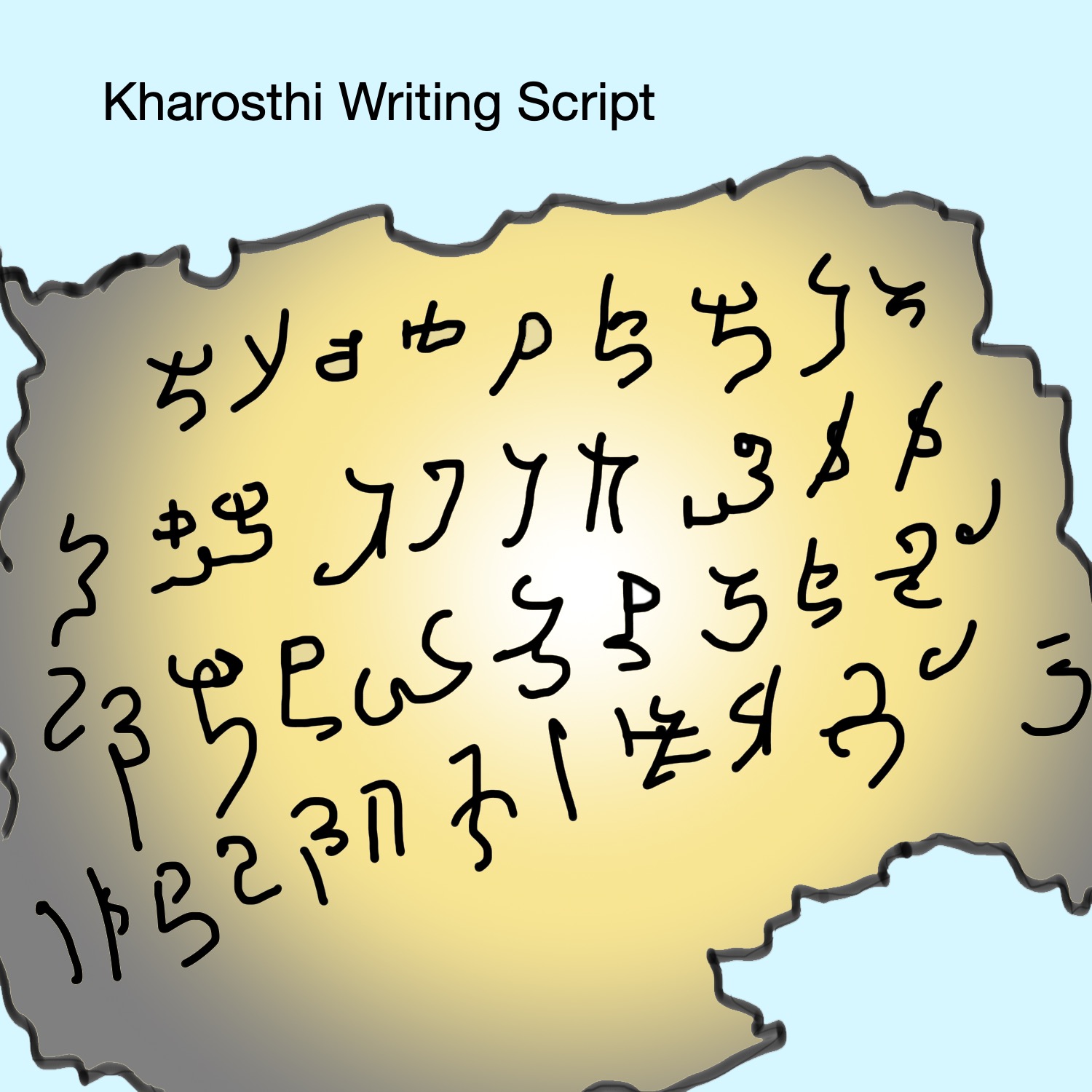
The Kharosthi writing script is strongly influenced by the Aramaic script and, like most Semitic scripts, was written from right to left. Its use was limited to northwest India but it died out by the second century BCE.

Brahmi Writing Script. Picture by @wantwotwee.

The Brahmi script, on the other hand, had a much more influential impact to the development of writing in India. It is likely that the Brahmi script was also influenced or derived by some Semitic script because initially, the script was also written from right to left before the direction was later reversed and remained written from left to right for most of its history. The Brahmi script developed a structural design that is adopted and can be found in many modern Indian scripts such as Devanagari, Tamil, Thai and Tibetan. Some scholars estimate that upwards of 200 scripts are derived from the Brahmi script and they have been applied to languages from four different language families: Indo-Aryan, Dravidian, Sino-Tibetan and Austronesian. Geographically, the Brahmi-derived scripts can be found all over the Indian subcontinent, in South-East Asia and in Central Asia.

Structural Design of Brahmi-derived scripts

The two major design features that define a Brahmi-derived script are: (1) independent or initial vowel signs and (2) diacritic vowel indication in postconsonantal position.

One example of independent and initial vowel sign is /a-/ in alpha where /a-/ exists independently of the other preceding signs /l/, /p/, /h/, and /a/. Not all writing scripts provide this possibility as they may encode the initial vowel with the preceding consonantal sign or in the form of diacritics or other markers. The development of initial vowel sign is expected of the Brahmi script as it was used to write various Pakrits or Indo-Aryan dialects that had vowel-initial words and syllables consisting of only vowels. However, the majority of syllables are of the CV (Consonantal-Vowel) type. The CV-type syllable gives rise to the characteristic graphic syllable of Brahmi-derived scripts called the aksara. An aksara consists of one or more consonants followed by a vowel but the vowel is not encoded by an independent vowel sign as in /-a/ in alpha. Instead, the vowel is encoded by a diacritic sign called matra which is adjoined to the consonant sign.

Usually, there is a consonantal base that ‘inherits’ a vowel. This inherited vowel can be superseded by the use of another vowel diacritic on that consonant. The most frequently-used ‘inherited’ vowel is usually a reduced schwa or ‘a’, which is usually transliterated as ‘a’. Below is an example of Brahmi matras and how it re-interprets the aksara for the consonant letter k.

Brahmi's system of aksara & matra for /ka/. Picture by @wantwotwee.

As you can see, the initial consonantal base has an inherited /-a/. However, with the addition of diacritic markers, the /-a/ can be replaced with an /-e/, /-u/ or /-o/ just as easily.

In Brahmi, as well as in some other Brahmi-derived scripts such as Tamil where there are syllables of the CCV type in the language the script encodes, conjunct consonant signs may be used where one consonant sign takes a reduced form graphically in the conjunct consonant signs. This shall be discussed further later on.

Devanagari Script

Hindi-Devanagari Script. Picture by Ketut Subiyanto.

The Devanagari script is the major script of Sanskrit and other Indo-Aryan languages such as Hindi, Nepali, Sindhi, and Marathi.

Devanagari's system of aksara & matra for /ka/.
Picture by @wantwotwee.

The basic make-up of the Devanagari script is the system of aksara and matra. For example, the aksara for /ka/ which contains the inherent vowel /-a/ can be modified with a matra like /-i/ to form /ki/. As you may have noticed, the diacritic /-i/ is used before the consonant. Another example is the matra /-e/ that is written above the aksara and /-u/ which is written below the aksara. Thus, in order to read the Devanagari script, you must view the unit two dimensionally and as a whole rather than a succession of linear consonants and vowels.

Conjunct Consonant '-lpa' in Devanagari script. Picture by @wantwotwee.

Devanagari also utilises conjunct consonant signs where one consonant sign takes on a reduced form such as, in many cases, omitting the characteristic perpendicular stroke on the right hand side of the sign. For example, the word 'alpa' which means small in Hindi is transliterated as a+lpa but is pronounced as al+pa rather than a+lpa. In this example, we see that the consonant sign for /la/ and /pa/ has been fused to form the new conjunct sign /lpa/ where the perpendicular stroke of /la/ has been omitted and fused into the preceding consonant sign /pa/. The initial vowel /a-/, however, remains as an independent vowel sign.
Virama used in Devanagari script. Picture by @wantwotwee.

Another innovation of the Devanagari script is the diacritic called virama. Virama is a stroke slanting from left to right below an aksara and if used, has the effect of muting the inherent vowel in the consonant sign. For example, in the consonant sign /ka/, if /ka/ is used with the virama diacritic it has the effect of producing the velar stop sign /k/. Virama is used only in word final positions when the word itself is used in pause or followed by a punctuation mark.

Anusvara used in Devanagari script. Picture by @wantwotwee.

Another diacritic that modifies the aksara in the Devanagari script is the anusvara. Anusvara is a dot placed above the aksara and when used in the consonant, has the effect of nasalising the consonant. For example, the aksara /pa/ can be modified by an anuswara to form /pam/. In Sanskrit for example, it is also possible to replace the anusvara with a nasal conjunct /n/ as in [əŋɡə] which means 'limb of a body' which can be written as either अङ्ग or अंग. 
Visarga used in Devanagari script. Picture by @wantwotwee.

Finally, the diacritic visarga can also be used to modify the aksara. Visarga is a colon placed on the right side of the aksara and if used, has the effect of producing a final fricative or guttural /h/ and homorganic echo of the preceding vowel. For example, the consonant /bho/ can be modified by a visarga to form /bhoh/ which means 'sir' in Sanskrit.

To summarise this article on the Devanagari script, Devanagari uses aksara as its main functional unit. The unmarked aksara is interpreted to carry the inherent vowel /a/ or a weak schwa. Diacritics can be written on the aksara which will then replace the inherent vowel of the aksara. Additional diacritics can also be employed to indicate that the aksara is not to be interpreted as an open syllable as in the case of virama, anusvara, and visarga.

Devanagari Script (Hindi)

Credits: 
Pexels.
Writing Systems: An Introduction to their Linguistic Analysis by Florian Coulmas

Follow & Subscribe
Instagram: @wantwotwee
YouTube: Expirius Videos

Wednesday, 18 August 2021

Ancient Writing Scripts: The Linear A Writing System


Linear A is a writing script used mainly on the island of Crete from the beginning of the Middle Minoan IIb period circa 1825 BC (Rehak & Younger, 1998) until the end of the Late Minoan I period circa 1490 BC on the island of Crete, with scattered survivals of the script outside of Crete surviving as late as Late Minoan IIIa1-2 period circa 1320 BC (Duhoux, 1998: 8). As you can tell from the dates mentioned, the Linear A writing script predates the Greek alphabet by about 1000 years and the writing script was in use during the same time period as Middle Egyptian hieroglyphs and Akkadian cuneiform writing scripts. In other words, it is a very old writing script.

The Linear A writing script has also been discovered on other Aegean Islands like Kea, Kythera, Melos, Thera, Samothrace, mainland Greece (Mycenae, Tiryns, Argos) (Davis, 2010), and even the Levant (Tel Haror, Tel Lachish) (Finkelberg et al., 1996).

Sir Arthur Evans has been credited with discovering the writing script in 1900 during his excavations of the palace in Knossos in Crete. Sir Arthur Evans named the writing script ‘Linear A’ after the writing script’s distinctive feature of utilising mainly combinations of lines (Robinson, 2009: 8). Many scholars have drawn parallels between Linear A and the Cretan ruins with the myth of a ‘Minoan thalassocracy’ that gained popularity among Classical Greek writers such as Thucydides (Starr, 1955). As the word thalassocracy implies, Minoan Crete were portrayed as a naval empire and among the many stories that emerged about the island from Greek mythology is the story of King Minos and his labyrinth, and the island being the birthplace of Zeus. Minoan wares and architecture were famed in the Bronze Age societies with mentions of the island found on several Middle Egyptian hieroglyphs and Minoan-style architecture found all over the Mediterranean.The discovery of the language behind Linear A would be fascinating as it can potentially re-write early western history as we know it. It could tell us who lived and built the great Minoan civilisation, the precursor of the famous Ancient Greek civilisation.


Linear A was not the only writing script found by Sir Arthur Evans in 1900. Alongside Linear A, the archaeologist discovered Cretan Hieroglyphs and the Linear B writing script. Cretan Hieroglyphics was used during the Middle Minoan period circa 2000-1700 BC (Rehak & Younger, 1998) and the writing script may be the progenitor of Linear A, although this proposal cannot yet be ascertained (Davis, 2010). Linear B is a writing script used from about 1450 BC - 1200 BC that was found to encode the earliest known form of Greek, Mycenaean Greek (Steele, 2017). The writing script was deciphered by Michael Ventris in 1952. Due to their graphemic similarities, Linear B is seen as a daughter script of the older Linear A writing script. Another daughter script of the Linear A writing script is the undeciphered Cypro-Minoan script found on the island of Cyprus.


Linear A remains an undeciphered writing script, and the main reason for this is due to the paucity of Linear A materials and lack of existing bilingual texts (Hooker, 1975) (Olivier, 1986: 383). Bilingual texts such as the Rosetta Stone and Behistun Inscriptions are how Egyptian hieroglyphs and the cuneiform writing systems were eventually deciphered. As a comparison, Linear B which was deciphered in 1952 by Michael Ventris appears on more than 4600 artefacts with signs occurring 57398 times while Linear A only appears on 1427 artefacts with signs appearing around 7362-7396 times (Younger, 2020: Section 5). With the limited sample size and the possibility that many words identified within the Linear A corpus could just be linguistic borrowings as well, this would severely reduce the possibility of discovering what language is being encoded within the writing script.

Use of Linear B Sound Values to Read Linear A Texts 


One step researchers used to decipher Linear A is to use Linear B sound values to ‘read’ Linear A texts (Hooker, 1975) (Olivier, 1975, 1986: 382-3). The Linear B writing script was used between 1450-1200 BC and its replacement of the Linear A script on Crete, which fell out of use shortly after Linear B’s introduction, is associated with the Mycenaean Greeks assuming palatial control over the island from the Minoans around 1450 BC. The methodology of using Linear B sound values has been criticised on the basis that 80% of Linear A signs are unique to Linear B (Younger, 2020: Section 7b) and correspondingly produces meaningless ‘words’ when read this way. A similar methodology employed to decipher the Carian language by comparing Carian symbols with Greek alphabets have shown that incorrect phoneme-grapheme inferences between writing systems can lead to incorrect reading (Adiego, 2006: 176-187). As Linear A represents a separate writing system, phonological adaptation and realignment must have taken place between the two writing scripts (Steele & Meissner, 2017).

Nevertheless, there are strong arguments to support the use of Linear B sound values to read Linear A texts. Statistical experiments by Packard (1974: 72-102) and Davis (2014: 246ff), the identification of place names within the Linear A corpus, and the argument for the acrophonic principle in writing scripts (Steele & Meissner, 2017) all lend evidence for the use of Linear B sound values to read Linear A symbols. Recent epigraphic studies for example showed that 64 out of the 89 signs are shared between Linear A and Linear B signs, giving a grapheme correspondence rate of 72% which is comparable to the relationship between late 3rd Century Latin alphabets and Old Italic alphabets which produced a 74% grapheme correspondence rate (Steele & Meissner, 2017). Sound values from related scripts have also been shown to be tenacious and remain largely constant over a period of time (Steele & Meissner, 2017). For example, the Linear B da (/da/) sign was borrowed into Cypriot Syllabary as ta (including /ta/, /tha/, /da/) while Linear B ti (/ti/) and to (/to/) also ended up in the t-series of Cypriot Syllabary but not di and do (See Fig. 1). This means that while the exact phonetic values of Linear A cannot be recovered with precision, the shared values would be close enough to be reconstructed approximately.

Alas, using Linear B phonetic values to read Linear A script produces mostly meaningless sounds that does not attribute to any known languages. Using the scant Linear A material researchers have to work with, a number of languages has been hypothesised to be behind the Linear A writing script ranging from Indo-European Sanskrit (Owens, 1999), Greek (Nagy, 2002), Semitic (Rendsburg, 1996) and Etruscan (Facchetti & Negri, 2003). Each one of the researchers assertions have their merits and justification, however, given the paucity of the linear A corpus and lack of known bilingual texts, it is not conclusive as to which language is behind the writing script.

Linguistic Research

One vital step towards a systematic study of the Linear A language is the consolidation of Linear A artefacts into an updated and scientifically redacted corpus (Oddo, 2007). Leaving aside Sir Arthur Evans ambitious but incomplete attempt, the first scientific publication of a Linear A corpus was done by Giovanni Pugliese Caratelli in 1945 with subsequent innovations, revisions and updates to the corpus providing researchers with better means and alternatives for analysing Linear A (Oddo, 2007). Currently, Godart and Olivier’s (1976 - 1985) GORILA corpus are regarded as the most authoritative work for any scientific analysis on Linear A although Raison and Pope’s (1980, 1994) corpora also offers alternative methodologies and approach that are preferred by certain researchers (Oddo, 2007). With these vital foundations in place, an internal and external analysis of the language of the writing script can be done.

From what we know about the writing script so far other than the fact that the script is linear and looks similar to Linear B, the Linear A corpus, like Linear B, has been found to mostly contain economic tablets (Palmer, 1995) (Petrolito, Petrolito, Winterstein, & Perono Cacciafoco, 2015: 96). This means that the Linear corpus would consist of mostly personal or place names. The most common combination of signs in the corpus is ‘KU-RO’, which in Semitic languages has the meaning of ‘all’ or ‘total’. Researchers have also managed to deduce the tallying system used in the tablets, thus we are able to tell how much of a certain object or person is being tallied, although we may not know what the object exactly is. The writing script also appears to have an added religious and artisanal use as evidenced by inscriptions on libation tables (Palmer, 1995) (Eu Min, Perono Cacciafoco & Cavallaro, 2019).

For more insight into the current state of linear A research, you may check out Younger’s website that aims to provide a general overview of Linear A researches and to refer to GODART’s GORILA corpus. As new linear a materials are found once in a while, it may be sooner than we think that the writing script be deciphered.

Thursday, 12 August 2021

The Economics of Axie Infinity

Axie Infinity was created in 2018 by a team of developers based in Vietnam called Sky Mavis. While the growth and popularity of the game was initially slow, within the space of two and a half years, the game have grown to be the number one blockchain game with more than a million active users and a market cap of more than one billion dollars. The game heralds itself as a play-to-earn blockchain game that promises to reward players based on the amount of time that they spent within the game's ecosystem. The new model is unlike that found in the traditional gaming industry where the earning aspect of the game are usually reserved for the game developers, investors, competitive e-sports players, or game promoters. After all, games are built for the purpose of leisure, the thing a person go to in order to take their minds off work, so why should a game economically reward its players?

The traditional gaming industry is a multi-billion dollar industry, but to use the term 'traditional' to describe the gaming industry is a contentious overstatement. The industry itself only emerged in the 1970s and even then the industry saw several major overhauls to its ecosystem as people's playing preferences change and new technological innovations are introduced. In just a span of a couple of decades, the gaming arcades and early gaming consoles that, just one generation ago, formed a fundamental part of people's lifestyle are now confined to a niche market of retro collectors and users.

Blockchain Technology

The current crop of blockchain games that have emerged in the past couple of months are still mostly at an early development phase, much like most other blockchain technology applications in the market. A quick search of the decentralised applications, or dApps, in the blockchain technology space will reveal mainly decentralised finance apps including yield farming apps. This was a concern raised by Ethereum co-founder Vitalik Buterin in the Ethereum Community Conference 4 event in Paris in July 2021. Money is an attractive factor to generate interest and attract investment into the technology space, but it should not be the prime factor as the concept of blockchain technology has other incredible potential uses that could revolutionise and capture the world's economy.

Blockchain technology is a useful technology that can bring better order and unity to a chaotic world and right now, it is at a stage where the technology is an idea, a belief at the back of people's minds. Blockchain technology will take root in our society one way or another because of its very useful application: its immutable ability to process transactions at possibly lower costs. As blockchain technology spreads and begin to entrench itself into our society, people will start to contribute more and more ideas about what we can do with this technology. It can be in insurance, health, journalism, or logistics. The technology has the potential to improve many of the current world's processes.

Blockchain Games - Egalitarian Multi-Level Marketing Schemes

Blockchain games promise to amalgamate blockchain technology with the gaming industry. One utility of blockchain technology is its ability to attract investments in the form of tokenisation. Anyone anywhere is able to create a fungible digital asset, or a token, that people are able to give a value to and trade for. For example, if I want to raise money to fund a Save the Turtles Project, I can create 10,000 Save-the-Turtle tokens and list in in one of many crypto coin exchanges. If people wants to invest or have a stake in my project, they can buy my token in the exchange by exchanging my token for another valuable cryptocurrency such as Bitcoin or Ethereum or fiat currency. Around April 2021, tokenisation reached a ridiculous hype and fervour with memecoins such as Dogecoin and Shiba Inu reaching market caps in the billions of dollars.

As it stands now, play-to-earn blockchain games can be described as a form of multi-level marketing scheme that is built on blockchain technology's tokenisation utility. Multi-level marketing (MLM) is a marketing strategy used where the revenue of the company is derived from the non-salaried workforce selling the companies product or service while the earnings of the participants are derived from a commission system. So, if I want to be part of a multi-level marketing scheme, I have to be roped into the scheme by another person and make a contribution and in order for me to earn I have to rope in more people to earn in commissions. MLM schemes could also be structured in a way where if the person I rope in brings in more people or investment into the scheme, I can get a referral commission or compensation. In such a structure, the higher you are in this MLM scheme, the greater your compensation will be and the greater the model is tilted to to represent a pyramid scheme.

MLM or pyramidal schemes are not fundamentally evil or wrong as it is often portrayed to be. It is simply an economic model or marketing strategy which can be used for other purposes besides pure monetary gains. For example, it can genuinely be used to attract interest into a company's new product or service at a rapid scale. Once the scheme reaches its zenith (maximum number of adopters possible in a market), the monetary rewards are no longer there but everyone within the scheme would have been introduced to the new product or service.


Play-to-earn blockchain games are a form of multi-level marketing scheme. The success of the game is in its ability to attract new users, and sustain its economy for the long-term. To play and start earning in any of these games, a player must first invest into the game by buying the game's assets which can be in the form of fungible or non-fungible tokens. If the game is popular and attracts a lot of attention, it would naturally attract new players and investors into the game. The unique difference between blockchain game projects compared to pyramidal MLM projects is that existing players can multiply their gaming assets and re-sell them to other players. 
Thus, the blockchain game can be shaped in a way it is more egalitarian in distributing the MLM profits derived from new players' investments.

Investing is not the only thing one has to do to guarantee a share of the MLM profits once they are part of the game's ecosystem. Continued participation is also another factor. If a person invests but does not participate in the playing aspect of the game, the person will not be able to multiply their gaming assets and earn by selling them. In this point of view, blockchain games are able to portray themselves as true play-to-earn models that de-incentivise passive players who do not want to spend time playing the game. Participation can be in the form of clicking a button several times a day or playing an elaborate strategy game. The game has to balance just the right amount of difficulty and ROI on people's time. Make it too easy or too quick to multiply your gaming assets, the value of the game's assets will plunge. Make it too hard or too difficult to multiply your gaming assets, people will be disinterested in the game, the game will not be able to attract new players and the value will plunge.

Another balancing aspect of the game's economy is also the rate of withdrawal from the economy. Contrary to some beliefs, the money earned from participation in the game's economy does not magically appear out of nowhere. As mentioned before, it comes from investments into the economy which in blockchain games are mainly derived from new player's initial investments. In the future, there is the possibility of injecting other sources of funding into the economy through other means such as franchising the game and selling toys or making movies out of the franchise. If a game is unable to regulate its high withdrawal rate and allow funds to be drawn out of the economy unchecked, the rate of return for everyone within the game's ecosystem will correspondingly diminish just as quickly as well.

Case Study: Axie Infinity

The Axie Infinity's economy was fine-tuned over the course of the past two and a half years. It had the benefit of a first movers advantage and time to figure out an economic model that would be sustainable for the long term because the game only had to grapple with a few thousand players for the large part of the two and a half years unlike some of the newer projects that saw parabolic increases in the number of players entering their ecosystem in a much shorter time period.

The game requires new players to purchase 3 NFTs from other players to start playing the game and the cost of each NFT is not cheap. An initial investment is anywhere between $1000 to $3000. The game, unlike many other blockchain games, also have a degree of complexity to it as players have to strategise in order to win games and earn gaming assets but it is not too complicated because anyone is able to win the easier levels to earn gaming assets. The development team occasionally revise the game assets ecosystem to account for changes in the market in order to maintain an egalitarian earning platform for all stakeholders and they also clam down on multi-accounts which, if left unchecked, would drain the economic resources and create imbalance in the egalitarian distribution of profits. There are also withdrawal restrictions in the form of game asset locking features that require players to wait two weeks in order to withdraw the main in-game token, SLPs.

The high amount of initial capital, the complexity of the game, the frequent policing to ban game exploiters, and the withdrawal limitations all combine to be a good recipe for a sustainable long term growth for everyone participating in the economy. Due to the nature of how inputs and outputs to and from the economy are regulated, it also prevents market manipulation of the gaming assets i.e. pump and dump strategies. In the future, there is the possibility of injecting other sources of fund into the economy through other means such as franchising the brand where the game developers can look into producing Axie movies, clothing line, or toys whose profit can then be channeled back into the game's economy.

Case Study: CryptoBlades

CryptoBlade's economy is one that was clearly designed to be a multi-level marketing scheme that is focused on the earning aspect of play-to-earn. The game attracts users with the prospect of earning a huge return within a short amount of time. A player simply has to spend about $250 to get four character NFTs and an NFT weapon to start playing and earn a return. Although the project portrays itself as a 'blockchain game', there is no element of gameplay within the game itself. Basically, a player must click on a 'Battle' button 8 times a day in order to earn gaming assets in the form of SKILL tokens. The earnings in the game are controlled by what the developers call the Oracle that decides how much players are able to earn from winning a match. This Oracle acquires data from within and outside of the game such as the price of the game's token, SKILL, and the rate of withdrawal from the economy, in order to sustain the game's economy and price of SKILL. That includes making hard decision such as allocating negative returns for playing the game in order to prevent the price of SKILL from dipping and the economy from crashing. The game also have almost no checks to control the outflow of capital from the economy because in order to withdraw your gaming asset, one simply exploit a loophole in the Staking mechanism of the game that allows players to withdraw their gaming assets within 7 days. Furthermore, multi-accounting is allowed resulting in early players creating 30-50 accounts in order to profit even more. At its peak somewhere around early July 2021, tens of thousands of people entered the game resulting in an influx of capital into the game. However, correspondingly, people were also withdrawing from the economy just as fast by creating multiple accounts. There were YouTube videos where players were seen withdrawing more than $50,000 a month from an initial investment of just $250.

In a matter of weeks after CryptoBlades blew up and reached its all-time high in July 2021, the economy started to crack. People within the game were withdrawing from the economy at a rapid rate and the amount of new investors into the game are reaching a slowdown. The price of SKILL started falling about 20% day by day and the Oracle began allocating lesser and lesser earnings per match for each player. By early August 2021, earnings within the game was negative meaning that if you play the game, you are actually making a loss because gas fees alone outweigh your SKILL earnings. The price of SKILL in the market outside of the game remained fairly steady but it is as the result of the Oracle's intervention. All these development just means that users within the game will not be able to earn anything while new users who were not aware of the Oracle's manipulation of the price of SKILL continued to enter the game, only to realise they will lose money from playing. 

The game developers are constantly seen engaging with players and trying to come up with better ideas and ways to increase the value of players earnings. In one of their AMAs, the developers were planning to increase the complexity of the game instead of simply clicking a button. However, with multi-accounts just waiting for the opportunity to seep capital out of the economy at a moment's notice, it is hard to see how the developers can address the apparent economic flaw in the multi-level marketing project that have already exhausted most of its resources.

Economics of Axie Infinity

Axie Infinity thus proves to be an interesting case study for future sustainable blockchain technology projects. The economic model is sustainable, attractive and egalitarian - a recipe for the future automatised humanist world that was envisioned by the most optimistic of technologists. In the short term, the economic model can also be replicated outside the gaming genre and can be used to support any kinds of project. It is thus interesting to find out what kinds of project can attempt to attract the attention that Axie Infinity is garnering from outside the gaming genre but the trails of success is there.

A new economic model is born.

Wednesday, 4 August 2021

Why Did I? Invest in the SGX

In this series of blogposts, I will be writing about the reasons why I had chosen to act upon certain decisions in the past, present or for the future. This series will help me to analyse my decisions on hindsight, reflect on the mistakes that I have made, and understand the reasons why I came to do certain things. My hope is to learn and immortalize my actions for my and my reader's benefits and perhaps be the subject of some social research in the future. Hmm...


Why I Invested in SGX Stocks in 2019.


In 2019, at the age of 24 years old, I invested in the SGX. I was in the final year of my studies and on top of the final year project and thrice a week classes, I finally had a lot of time in my hands. Gone were the days of juggling 3 leadership portfolios and overloading on my semesters. My grades were firmly in the second upper class range no matter what grades I will be getting and by this point in time many of my friends were no longer coming to school at all. Thus, I had time to think about a lot of things.

Among the things that I took an interest in was investing. In 2017, I had started investing in Singapore Saving Bonds using my NS pay savings. Every half a year, I get that extra $10-$20 from the SSBs and it felt good. However, I was dissatisfied as I was sure that I could be earning much more elsewhere. Over the years, I had been saving about half of the pocket money from my parents (yes, I was still getting pocket money of $80 a week from my parents in university to which I am grateful for) and have idle cash in my bank accounts.

I did two things with the cash that I had. One, open a drop shipping business (which I will be talking about in another blogpost), and two, start investing in the SGX.

Trading Stocks in the SGX


The Singapore Exchange Limited is an investment holding company in Singapore that offer companies a way to raise capital in exchange for shares of their company. If you buy some shares of the company, you own a little bit of the company too and owning a part of the company entitles you to certain privileges depending on the share that you bought. This includes voting rights in major decisions for the company and entitlement to a portion of the company's earnings, also known as dividends. The greater the shares that you own, the greater the voting power that you have and the greater portion of the earnings that you are entitled to.

There are many articles out there that will be better able to guide you if you are interested in trading in the SGX but in this blogpost I will summarise the steps as briefly as I can. First, you will need a broker. A broker is an entity that buys shares for you. There are two types of brokers. Custodian and depository brokers. In buying shares through custodian brokers, you do not technically own the shares that you bought as it is owned in the name of the custodian broker's account. Shares bought through a depository broker on the other hand are fully owned by you. As such, buying through custodian brokers are usually a lot cheaper than depository brokers. Some example of custodian brokers include the now famous Tiger Brokers while a depository broker is like DBS Vickers.

If you choose to trade shares using a depository broker, you will need to open a Central Depository (CDP) account to store your SGX shares. The CDP is a treasury of sorts for clearing, settling and depositing your Singapore securities. For custodian brokers, the company that you are investing through would also have a CDP account of their own where they hold your shares. More steps to open a CDP account can be found in the SGX website: https://investors.sgx.com/cdp-account-opening/#/form-selection. After opening your CDP account, you can choose a depository broker to buy and sell your shares with,

What I Did

After weighing the pros of cons of choosing a broker to trade, I opted for DBS Vickers, a type of depository broker. As such, I had to first open a CDP account. By following the easy-to-follow guide on there CDP website I managed to complete my application within a day and submit. Within one week, I received a letter about the successful opening of my own CDP account, thus enabling me to start trading SGX shares almost immediately.

I then proceeded to create a DBS Vickers account. Setting up and understanding the site takes a little while to get used to. It was only after making several trades that I became less afraid of making changes in the site for fear of putting a trade that I cannot afford or worse. I did not fully understood how the interface works. However, once you get used to looking at the charts and knowing the call options that are available, you will pretty much be an expert (to a degree), in using other trading platforms including platforms to trade cryptocurrencies as they are identical. Another thing that I was not aware of when I first started trading was the option for paying using Cash Upfront vs Cash option when Buying shares. If you are executing a Buy option on a stock that you already have the funds for and are not buying on Margin, then you should use the Cash Upfront option which have much lower fees than the Cash option. This would save you greatly especially when you are investing in smaller sums like when I was starting out. {$1000-$5000).

The first stock that I bought was DBS (SGX: D05). I bought 100 shares at $25.30. DBS is a blue chip stock, meaning that it is a big company with a very large market cap. As it was my first time buying stocks, I wanted to take minimal risks and DBS was perhaps the least riskiest option there is in the SGX. I would recommend people who are trying out to invest first in blue chip companies as a way of trying things out. 

As a first timer, after buying the stock, I found myself checking the share price every day. I was happy as for the next few days, the stock price immediately started rising but falling a little but never going below the price I bought it for. It took about 3 months however when a major news about DBS came about and I saw the stocks I bought rose in value to about $28. I was euphoric. However, just as bull markets run, the bearish cycle starts at some point or another. The price fell to around $24 about a few months later. In stock trading, you will often get a lot of this guilt feeling such as "I should have sold it at this price" or "I shouldn't have sold it so soon". This is normal. One thing that I learn over the years in trading, it is really impossible to time the market which is why there are advocates out there who insists on buying a little at a time once a year or once every several months. An important lesson I learnt was that you must have an exit strategy or some kind of strategy to reap the benefits of your investment.

I was earning a 5% dividend yield from my DBS investment which I thought is good enough for me because my SSB yield was around 1.5-2% only. I also thought I would hold on to my DBS stocks forever and just receive the dividends indefinitely. At this rate, it would take me >15 years for me to see a full return of my initial capital. After receiving my first dividend payout for DBS, a cool ~$25, I decided to buy another stock, SGX: HMN, Ascotts Residential Trust. It is a REIT, which means it is a real estate investment trust, and the company invests in serviced apartments and hotels. I was attracted to REITS due to the strong and stable returns the REITS market was producing around the time I bought it in September 2019. I bought it at $1.31 and I spent another $2500 for HMN.

Stock Market Crash


In March 2020, the impact of Covid-19, then called the Wuhan Virus as it was first discovered in Wuhan, China, became apparent as the virus raged all across the world, changing our lives forever. From hundreds of cases, millions became infected and the death toll rose to hundreds of thousands. Countries took aversive measures, although many were too late. People started working from home, public events were essentially non-existent and travelling was banned. That changed the lifestyles of many and as expected it caused the stock markets to crash. Without many of the businesses not able to earn any money as the world grinds to a halt, it does not make sense to remain invested in companies that are not generating income. The worse hit were the airlines, travel and REITS companies.

My portfolio essentially crashed about half of its value before March 2020. Ascotts were trading at around $0.80 and DBS went to around $18. I lost between 30-40% of my initial investment. Instead of just rueing, however, I decided to take action. The way I see it, when a market goes down there will still be companies that survive and these companies are at a huge discount now. My action paid off.

In March 2020, I bought $1000 worth of Bumitama Agri (SGX: P8Z). I was being more bullish now. I told myself if I made just 10% of my investment I will sell. I made 12% the following month, I immediately sold. Then I bought $1500 worth of Food Empire (SGX: F03) on June 2020 and it rose by 17% the next month, I immediately sold. I bought $2500 worth of SingMedical (SGX: 5OT) in Sep 2020 and it rose by 17% in 2 months, I immediately sold. The price of all the 3 stocks I chose to buy and sell eventually rose by more than 100% but I was happy with my gains because at the end of the day, the losses to my portfolio was mitigated by my aggressive buy and sell strategy during the pandemic. DBS eventually recovered to it's pre-pandemic value by Nov 2020 and when it reached 10% gains, I sold the stocks too. Only Ascotts, which reported more than a billion dollar in losses in 2020, had not recovered at the point of writing, and is now trading at around $1.

The stock market as of mid June 2021 have more or less recovered and is in a bull cycle right now. The pandemic have inculcated in me a more bullish attitude towards trading SGX stocks. When I invest in a stock now, I have an exit strategy of cashing out after making 10% no matter what. I also realise that I should trade in larger volumes to offset the brokerage fees. As such, I invest a minimum of $5000 per trade now. My bullish strategy has been working so far. I invested and sold my shares in QAF Limited and Yangzijiang Shipbuilding in 2021 and my investment returns are now at a 25% profit. After cashing out on QAF Limited in May 2021, I now only hold Ascotts and China Sunsine (SGX: QES).

The SGX market is a lot less volatile than the US stock market or Crypto, thus the potential to earn from your investments are a lot less. On average I would have to see 2-3 months to see profits but the earnings, if I carefully research the undervalued stocks to purchase, are there to reap. I have investments in Bonds, Unit Trusts, Crypto and SGX stocks, and out of them all, SGX stocks and Crypto trading are my favourite and most lucrative investment options. For the average salaried worker, perhaps this stock trading can be a past time to look forward to once a month and reward oneself with.