Sunday, 31 October 2021

The Brahmi-Derived Writing Scripts: Tibetan and How to Read It

The Tibetan script. Credits: Wan Ariff


In a previous post about Devanagari, we have looked at a brief history of Brahmi-derived scripts and the two characteristics that define a writing script’s relation to the ancestral Brahmi writing script. As a recap, the two major design features that define a Brahmi-derived script are: (1) independent or initial vowel signs and (2) diacritic vowel indication in postconsonantal position. This is realised as the system of aksara and matra in Devanagari & Brahmi. In this post, we will be looking at a different Brahmi-derived writing script, the Tibetan writing script.

Thonmi Sambhota. Credits: WikiCommons.


The Tibetan writing system dates back to the 7th century of the Common Era as a syllabic script. It’s origin is not well attested, but it is widely assumed to be patterned on the Gupta script which is an offshoot of Brahmi and flourished with the great Gupta Empire until the 6th century of the Common Era. Another theory to the creation of the writing script is that it was invented by a minister called Thonmi Sambhota around the mid 7th century who had travelled to India and invented the script based off the Nagari script, a script that would eventually develop into the Devanagari writing script.


The Structure of the Tibetan Script


Yi ge. Credits: Wan Ariff

The Tibetan writing script is written from left to right. The basic functional unit of the script is the Yi ge, which is the equivalence of an aksara in Brahmi. Yi ge are basic consonant signs that each contain an inherent vowel a and there are 30 Yi ge in the Tibetan writing script. Diacritic markers are added to a Yi ge to change the value of the inherent vowel from an a to a different vowel. There are 4 main vowel diacritic markers and these are for I, u, e, and o. For example, the symbol for the voiceless velar consonant ‘k’ is pronounced as ‘ka’ when used independently. However, if we include the superscript for -I, the symbol is read as ‘ki’.


Vowels in Tibetan. Credits: Wan Ariff


Unlike other Brahmi derived syllabic script, the Tibetan writing script only has one independent vowel symbol which is for ‘a’. Hence, if one wishes to write a word that starts with a vowel other than ‘a’, one has to use the independent vowel symbol for ‘a’ and use it with another of the other vowel diacritic. For example, this is the symbol of what 'o' would look like.


The paucity of vowel letters makes for difficult reading as vowel signs take on multiple values. To exemplify this difficulty, Modern Tibetan has 12 distinct vowels and 2 tones in the language, but the Tibetan writing script only has five vowel signs that are distinguished while tones are not marked at all.


Vowel length. Credits: Wan Ariff

To compensate for the vowel deficiencies in the writing script, several innovations are introduced. The Yi ge for ‘h’ called the achung can be used as a diacritic marker to create a long vowel. For example, to make 'phaa', I can simply add the achung as a subscript.


Consonant Cluster. Credits: Wan Ariff


The Yi ge for ‘j’ can also combine as a diacritic to 7 other Yi ge to form conjunct consonant signs like ‘kya’ and ‘pya’. The Yi ge for ‘l’ can combine with 6 other Yi ge to form conjunct consonant signs like ‘’bla’ and ‘zla’. Like other Brahmi-derived scripts, the graphic syllable is a two-dimensional form to be interpreted as a whole instead of a linear string of consonants and vowels. 


In the Tibetan script, the internal structure of the ligature may no longer correspond to the phonetic interpretation. This is primarily due to the language behind the writing script changing without the writing script being reformed accordingly. A similar phenomenon can be found in French where written words often take on the form of how it was once pronounced before the language behind the script changes and in some English words such as knight where the ‘k’ used to be pronounced in Old English. Thus, in the Tibetan writing script, the prescript for ‘b’ and the postscript for ‘d’ are common vestigial remnants and are not pronounced when read.


Tsheg. Credits: Wan Ariff


A diacritic marker called tsheg, written as a superscript dot on the right shoulder of a Yi ge indicates the syllable closure. For example, ‘sa’ and ‘da’, combined with a tsheg on the ‘da’ symbol will form ‘sad’ which means ‘to awaken’ in Modern Tibetan. Two consecutive Yi ge without a tsheg to separate the symbols are to be interpreted as a consonant cluster. However, it is also possible to simply separate the two Yi ge in isolation to achieve the same result. This structural possibility would imply that technically, the Tibetan writing script can be structured more linearly compared to other Brahmi-derived scripts but as we can see from an analysis of the writing script, the functional unit of the writing script is still the graphic syllable.


Other non-phonetic markers. Credits: Wan Ariff


The Tibetan script also has a unique array of symbols and markers to represent extra phonetic elements. You may find the yig mgo that marks the beginning of a text, the sbrul shad that separates topic from sub-topics, the tshig-grub that marks the end of a section, the don-tshan that marks the end of a topic, the gter-tsheg that is used like a comma, and the gug rtags gyon & gyas that is used like a brackets. Furthermore, the Tibetan script also has a set of numeral symbols of their own that are different from the arabic numerals.


Basic Yi ge. Credit: Florian Columns


Sunday, 24 October 2021

The Man Who Can See Constant {Chapter 4: What is Consciousness}

I know that many people would not believe me when I tell them that there is a man who flickers and can see Constant. It contradicts their senses and beliefs about the laws of this world. I have given some thought as to why people may choose not to believe some stories but then easily choose to believe others, and I think it is imperative that I explain it to you.

In my opinion, our beliefs are created by our consciousness. But what is Consciousness? Some people define consciousness as our ability to be aware of things. My belief is that consciousness is an inherent tool that humans possess that separates truth from falsehood. Another property of this tool is that it is social in nature; in order to validate whether a concept or object is true, you need another being to confirm its existence.


Let me explain, and I hope my explanation can be as enthusiastic and well-explained as The Flickering Man’s. We are all predisposed with sensory organs that had developed over thousands of years since the time our ancestors were primal apes in the grasslands of Africa. Eyes enable us to perceive a certain range of light. Ears enable us to perceive a certain range of sound waves. Skin allows us to perceive a certain range of temperature. Tongue allows us to perceive a certain range of taste. Nose allows us to perceive a certain range of smell. These are evolutionary developments that help the human self to receive inputs from the external environment. Our development is not unique to other life forms on this planet. In fact, some species of apes like the chimpanzees come very close in biology to humans that their sensory input could very well be similar if not better than us humans.


But sensory inputs without consciousness would render all these sensory inputs meaningless. Without the tool to determine if our sensory inputs is real and has value, we would be able to perceive, but not acknowledge or understand them. This inability would render non-humans to live by the natural cycles of the world, blindly driven by their own chemical hormones and changes in the external environment.


So now, let me try to explain how our consciousness tool work. I see a red ball lying on the sands of the beach. The ball belongs to the external environment. Red light waves bounced off the ball and is captured by the photoreceptors in my eyes. I think the ball is lying on the sands of the beach. I think the ball is red. I think gravity is keeping the ball lying motionless. I think that the ball is about ten metres away from me. This process is what humans and other organism that have similar sensory input organs experience an infinite number of times at every given second. However, without the ability or tool to comprehend the realness of the ball, these experiences never amount to something significant to me. Some people may argue and bring up the defence that animals too can comprehend their surroundings and make sense of them to manipulate their environment in their favour. I acknowledge that they are able to manipulate their environment, but I disagree in relating the similarity in how we comprehend compared to non-human beings comprehend things. Theirs is a system of acculturated motions and instincts - I do this, I get a response like this - but in humans, our comprehension is based on, first and foremost, determining the realness of something and then trial and testing more logic to eventually create an understanding.


Thus, the second part of this consciousness tool theory is the inherent truth-value tool - a social tool because you will need another being for it to work. In the example of the red ball, I can only know that the ball is real by verifying it with another person. A person can kick the ball to me. My assumptions on gravity and the weight of the ball is verified. A person can point to the ball. My assumptions that the ball exists and the distance of the ball to me is right. A person can ask for me to get 'the red ball’. My assumptions about the colour of the ball is right.


There is an interesting fact that blew my mind the other day and that is, we cannot actually know if another person perceive colours the same way we perceive colours. You see, photoreceptors in our eyes receive photons from light and these photoreceptors converts this input into electric signals that the brain interprets. However, research have shown that the number and type of photoreceptors vary from person to person and just like fingerprints, are actually unique from human to human. Thus, each person should be receiving inputs of colours differently from another person. My orange is not your orange! But there is one thing we can all agree and that is, my orange colour (the way I see it), is also your orange colour.


Thus, when I tell you that there exists a Man that Flickers and can see Constant, I dare not expect many to believe me because they themselves have not seen a man that can flicker or see Constant, nor verified this phenomenon with someone that has met such a Man. Perhaps you may have seen such a man in a sci-fi flick, and thus this plausibility is perhaps… plausibly real to you. For me, although by my definition of the consciousness tool the realness of this Man is if I can verify his existence with another person, I had verified his existence when I interacted with him whom I consider a conscious being. Thus, for me, forever, he exists. The Man Who Can See Constant.


Sunday, 17 October 2021

The Man Who Can See Constant {Chapter 3: People With Compasses in Their Heads}

On Wednesday, I kind of expected to see The Flickering Man already seated at the same spot that I had left him the day before where I had my lunch. My expectation was partially right. The Flickering Man was still in the park but he was not seated. Rather, he was pacing back and forth between the fountain and the park bench where we had sat. So I made my way towards him and as soon as he saw me, I saw the widest grin that I had seen from a man in this city forming on his face.

“Hello there. I reached a little bit of a eureka moment this morning and I wish to share this fascinating discovery with you. Come, come, please take a seat,” The Flickering Man beckoned me to a seat.


I made my way round to a park bench and took a seat. After I was comfortably seated, I lifted the lids off my lunchbox and took out the ham and cheese sandwich which I had made for myself in the morning and pre-heated in my workplace’s pantry oven. I watched as The Flickering Man continued to pace back and forth. I saw that he still had on his grey Oxford shirt and khaki pants, but he had swapped out his boots for more normal dress shoes. With his shirt tucked out, he almost seemed like a typical city man on a weekend drink with his friends. The Flickering Man stopped pacing about a metre away from me and looked up to face me.


“Languages. Do you speak different languages?” The Flickering Man abruptly asked.


I can speak two languages… Although I am only really proficient in one.


“Do you think that you think differently, or feel different, when you speak in a different language?” The Flickering Man prompted me further.


I’m not sure… But I feel like I can better explain certain things in one language than another.


“What about directions? Can you tell where is North and where is South?” The Flickering Man probed me, in what appears to be a discontinuity from his previous line of questioning.


If you get me a compass, or if I observed the Sun, I suppose I can tell you the cardinal directions.


“But what if you close your eyes or are indoors. Can you still tell?”


No, of course not.


“But some people can.”


They do?


“Yes. People who speak Guugu Yimithirr in Northern Queensland in Australia.”


That is interesting.


“Indeed. They are not the only ones who can, however. People who speak Tzeltal in Southern Mexico, Marshallese from the Polynesian Marshall islands and many more across the globe. They all have the ability to tell you the cardinal directions, even if you were to blindfold them and spin them around more than 100 times!” The Flickering Man informed me.


Like having an internal compass.


“Exactly! Although… not as perfect as an actual compass.”


Why are you interested to find out about this peculiar ability of theirs?


The Flickering Man’s face turned a little serious.


“Your curiosity yesterday set me on a quest of discovering the limitedness of your beings’ perceptual faculties,” The Flickering Man explained. “I wanted to discover what exactly can you perceive and what can you not. I thought it could help me too since if I knew your being’s perceptual limits, I can better ease myself into your universe and try to be a part of it’s cycles. Thus, I had travelled the globe, met all of these amazing people and discovered this extraordinary discovery”.


You went to all of these places in one morning?


“Yes,” The Flickering Man casually replied, as if it is something un-extraordinary at all. “The people with compasses in their heads, they can perceive direction like you never could without the use of external tools. Do you know what does this mean?”


No, you tell me.


“This means that you have an internal device or system already embedded within your psyche - language - that could enable you to expand your own limited perceptual faculties,” The Flickering Man revealed excitedly.


But as you mentioned, isn’t an actual compass a lot more useful in increasing our perceptual abilities?


“Yes. A microscope, an X-Ray machine, infrared glasses or maybe even those ghost detection devices some ghost-hunters used. All these machines could, in many ways, expand one’s perceptual abilities more than a language probably ever could,” The Flickering Man agreed.


There was a pause in our conversation. During the short pause, The Flickering Man walked towards me and plopped himself down onto the seat beside me.


Is there a tool out there that could help us perceive everything?


“You mean to see Constant?”


Yes.


Another pause. The Flickering Man turned to face me and I could see now he was grinning from ear to ear again. He was practically beaming.


“There is. And it is more of a language than it is a tool,” The Flickering Man told me.


Really? What is it?


“Maths! Maths is the language of Constant. Understanding maths and using it to study the world will allow you to perceive Constant.”


I closed my lunch box. I had finished my meal. 


I know a little Maths. Why can’t I perceive Constant?


“You have to apply it to the world and see if the Maths’ integrity holds. If it holds, you would have discovered and perceived Constant,” The Flickering Man told me.


How about social constructs, like my relationship with people. Those seems pretty constant to me.


“Unfortunately, emotional attachment is perhaps one of the most un-constant-like thing in this world and belongs to the cycles of cause and effects that began when this world began. If the ones you have a relationship with abandoned you, scarred you - emotionally, physically, or mentally - you may lose your feelings of attachment for them. Some night say emotions are justna play of chemical hormones in our heads. And chemicals, they are a part of the natural cycles of this world, so it is not a Constant.”


What is a Constant then?


“You’ll have to observe the world a little deeper if you truly intend to perceive Constant. Look around you and look past the immeasurable cycles of this world. Constant is everywhere around you. It is in everything.”


I looked around the park. I looked at the trees, the leaves that had fallen onto the ground, the birds, the buildings. I hear the sound of a car horn in the distant and the sound of birds chirping. I see the thin sliver of sunlight that creeps through the oddly-shaped building.


Light. When there is light, like that sun ray over here, and I try to touch it or catch it with my bare hands, my hands will just pass right through it. But I know… I know that the light is always there and will always be there in that space. So is Light a Constant?


“A great observation. In observing and understanding Light, you can perceive a property or facet of Constant. One could describe Light as a symptom of Constant that humans are able to perceive. Did you know that Light travels at exactly 299 792 458 metres per second in a vacuum?”


I think I’ve read about it before.


“It is a peculiarity because it means that no matter where you are observing light from, be it you are travelling at a thousand kilometres per second or just standing still, light will always be observed to be travelling at the same speed. Is that not proof enough that Light is a symptom of a Constant universe out there? A universe or dimension that you are not yet able to perceive?” The Flickering Man asked me.


I stretched out my hands to touch the sliver of light in front of me. And I knew, I had closed my hands around a piece of Constant.


Sunday, 10 October 2021

The Man Who Can See Constant {Chapter 2: The Blind Earthworm}


The next day as I walked to my afternoon spot on the park bench, I had a cup of instant noodles in my hand that I had bought from a 711 nearby. I saw The Flickering Man already seated on the spot I had left him the previous day. He no longer had his trench coat on, but instead, he wore a grey long-sleeved Oxford shirt. He did, however, still had on his khaki pants and heavy boots.

There had been a heavy tropical rainstorm the night before, thus the park had puddles of water everywhere and the air felt cooler and wet. Instead of taking the seat beside The Flickering Man, I decided to sit on the empty park bench just next to the one we were sitting on.

The Flickering Man was not flickering anymore and he had a rather calm expression on his face as he sat back enjoying the cool breeze that blows through the park. It seemed to me as if he had not noticed my presence at all. As soon as I was comfortably seated, I peeked under the aluminium cover of my cup noodles. The noodles were no longer hard and they had become that perfect slightly soft but also slightly crunchy texture that I enjoy. I broke my chopsticks and was about to dig in when I noticed The Flickering Man beckoning me towards him, somewhat excitedly.

I pointed to myself, as if to ask, “Me? You want me to go over to you?”

He nodded. So I got up with my cup noodles and went to sit beside him.

“I wish to apologise for not being an accommodating guest yesterday. I feared I could lose touch with this world of yours and just disappear. Thus, I was so focused in trying to make sure that I didn’t. I am usually not like that. It is not always the case that I found just the right condition to be able to interact with someone or something that has awareness such as yourself because most of the time, I live in the blind cycles of the universe,” The Flickering Man told me.

I asked him why he was flickering the day before.

“The flickering is simply me trying my best to represent myself in a way that I could be perceived by you and the other beings that have the same perceptual faculties such as yourself. I did not quite attune myself right yesterday, causing me to only appear to be flickering but I assure you that my existence is as real as you or anything else that you can perceive,” The Flickering Man explained, or tried to at least.

But humans can’t flicker.

“Well, I wasn’t flickering. Like I said, it is your perceptual faculty that makes me appear to be flickering. I am not some kind of light bug that have the ability to generate and create its own light, if that is what you are implying,” The Flickering Man pointed to me then back to himself.
Is there something wrong with my, um, perceptual faculty then?

“No, nothing of that sorts, but your perceptual faculty is limited. Everybody’s perception in this world is limited in some way or another. But if I may add on, it is probably more of a good thing that they are,” The Flickering Man assured me.

I didn’t quite understand what he meant that my perception was limited. As far as I know, I have flawless eyesight, and all my other senses are in excellent condition. Thus, in between slurping my noodles, I asked him how exactly are my perceptual abilities limited.

“How do I put it… Look there.”

The Flickering Man pointed towards the puddle at our feet. I looked at where he was pointing at. The puddle showed the reflection of the two of us sitting on the bench, the trees were swaying gently behind us, and the tall skyscrapers in the background loomed magnificently overhead. What was he trying to show?

Then, I saw it. Or rather, I saw something move. There was a small air bubble and an ever so tiny ripple near the middle of the puddle. It was an earthworm. In fact, the longer I observed the puddle, the more earthworms of varying sizes that I could spot swimming lazily in the puddle.

“The earthworms… Do you see them?” The Flickering Man asked me.

Yes.

“They can’t see you, can they?” The Flickering Man asked again.

No, they can’t. They are earthworms.

“Yes, earthworms are born without eyes. They were created that way. They never had the perceptual faculty to see or perceive light. The same goes for cave critters or many deep sea creatures that are also unfortunately, or fortunately depending on how you look at it, not naturally imbued with eyes.”

But I have eyes. I am human.

“Do you think the earthworms know that they cannot see light?”

No, I suppose not.

“They don’t. They are blind to the entire world of light and colours. But are they missing out? Probably not. From their point of view, they have a universe of their own which they continue to perceive and interact through their limited senses and I’d like to think it is enough to keep them occupied. And to you, though you may think you have all the senses in the world, you don’t, and you probably aren’t feeling bogged down by that limitation anyway, are you?”

No, I suppose not.

That was the very first lesson that I had from The Flickering Man, and a very important one it was. There are really a lot of things in this world that I don’t know of, that maybe I should know, but I just didn’t. I was content, and oblivious, with my limited perceptual faculties. Just like that gently swimming earthworm.

Is there someone who can perceive everything then, or someone who can perceive more than what ordinary humans can?

The Flickering Man fell silent for a moment at my question. I took the opportunity to slurp on my cup noodles because they were getting colder by the second. I saw his eyes fell a little, or maybe I didn’t.

“Beings that can see Constant can perceive almost everything.”

Can you see Constant?

“Yes.”

I looked down at my cup noodles. It was almost finished.

Monday, 4 October 2021

The Man Who Can See Constant {Chapter 1: Meeting The Flickering Man}

My life changed the moment I met The Flickering Man. I called him that because using his name never quite seem right given the extraordinary nature of his existence.

I remember the day I met him for the first time. It was just a typical warm humid weekday afternoon in the city and I was having a satisfying lunch of overstuffed kebab in a park near my workplace.The park has a dull fountain in the middle, about five park benches surrounding the fountain, and a couple of trees lining behind the park benches. Tall towering skyscrapers loomed outside the park’s boundary, shrouding the park in perpetual shade.


I was sitting on one of the benches having my lunch while observing the pigeons shuffling on the paved floor when I felt a figure taking a seat right next to me. That day, there was only one other person in that park - an old man who appeared to be sleeping, sitting across us. Thus, it felt strange to have this person come sit right next to me when all the other park benches were unoccupied. My first thought was that it was a colleague from work that had found my afternoon shrine and decided to talk about some work. If it was, I think I would have studied the city map once more to locate the next park space to enjoy my lunch in peace. But it was not. It was The Flickering Man.


I stole a glance at the person from the corner of my eye. It was a man. He was wearing a dark blue trench coat, a pair of long khaki pants and a pair of heavy boots. A fairly odd attire for the tropical city that I live in where the temperature outside never falls below 25 degrees celsius. The man had both of his hands tightly gripped over his knees and a look of utmost concentration on his face as he stared at the pigeons ahead of us. 


Then, he flickered.


I blinked. Perhaps it is an optical illusion, so I thought. With light creeping past the cracks in the metallic buildings around us at weird angles and intensity, perhaps the light had played a trick in my eyes. 


But he flickered again.


When something noticeably strange occur, it is natural that we address the occurrence and then we react to it. The universe compels us to do so. Ignoring the strange event is simply detaching oneself from the natural cycle of this world, and in doing so we will most certainly create an even more abnormal chain reaction of events far greater than the original events. For example, when a blazing inferno erupted right in front of you out of nowhere, it is most certainly unnatural for you to continue walking into it. Someone watching you will feel compelled to scream or come rushing at you to pull you away and then they may get burnt, and when they get burnt, their family will be distraught, and when they are distraught, they will want to blame someone or get compensation from the insurance company. The insurance company will have a field day trying to paint the incident as an act of God just so they can escape having to compensate the victim. It will be an irony because technically, if you believe in a God, everything is an act of God. The point is, in your ignorance of the sudden change that had happened, you had induced a chain reaction of otherwise preventable, non-existent actions into being. It is best to just go with the flow.


Thus, I had turned to face The Flickering Man to confront this abnormal situation.


Good day to you. Is it just me, or are you flickering?


“Good day to you too! And yes! If that is what you perceive, then I most certainly am… I am trying not to, however, but it has been a while since I tried to tune myself to the cycles of a particular world and a particular moment and it definitely has been a while longer since I had to attempt to acculturate myself to the perceptual faculties of beings who are aware of the laws of their world such as yourself, but I usually get it right in the end!” The Flickering Man broke off from his staring of the pigeons and turned to explain to me. Or at least he tried to.


“Right then. I have got to get it right this time, shouldn’t I? There is just that specific narrow view of it that people can perceive. I certainly hope I do not appear like some horrendous scary all-terrifying demon,” The Flickering Man continued.


You don’t look like a demon.


“That’s a relief isn’t it? If I was, I’d expect you wouldn’t be sitting calmly beside me like you are now. You see, if I don’t get this right, I could appear like a static tree, or I could just disappear. Well… technically I won’t disappear, because I will still be here here. If that makes any sense to you,” The Flickering Man chuckled. “I can see you starting to look a little confused. Maybe I can try to explain it better some other day, but not today! If you don’t mind, I need to concentrate so that I can stop flickering!”


With that, The Flickering Man turned back to face the pigeons and continued staring intensely at them. The Flickering Man remained silent that day except with the occasional humming and grunting, and, of course, flickering.


My phone alarm beeped, indicating that my afternoon break was over. I wolfed down the remainder of my kebab, stood up, threw away the wrapper and as The Flickering Man was still busy, I decided to just leave him there. I thought my encounter with him would be the last time we met.


As it turns out, it wasn’t.

Thursday, 16 September 2021

Crypto Guide Part 1 - How to Create a Wallet to Store Cryptocurrency in Singapore

Blockchain technology took the world by storm a couple of years ago and the market for blockchain-related products have grown to more than a trillion dollars. Some people consider the market as pure speculation on nothingness while others consider the market as an opportunity in terms of investment or solving real world problems. Nevertheless, to navigate this space, one needs to acquire a minimal understanding of the market and the various entry points. In this series of blogpost on Crypto Guide, I will be explaining from a user perspective the steps that I have learnt and used to navigate the blockchain technology space. After this guide, I am sure that navigating the space is not as daunting as it may first appear to be, and a whole new world and community will be revealed to you.

[Part 1] Purchasing My First Cryptocurrency: Creating a Wallet

Before you can purchase your first cryptocurrency, there are several things you have to do. First, you need a wallet to store your cryptocurrency and to make transactions. This step is optional if you just intend to trade cryptocurrency in an exchange. However, if you wish to explore the world of blockchain technology, it is imperative that you acquire a wallet.

There are two kinds of wallet: a hot wallet and a cold wallet. A hot wallet is a digital wallet that stores your crypto on the internet. A cold wallet is a physical wallet that you store outside of the internet. There are pros and cons to having a cold or a hot wallet. Personally, I trust the security of the exchanges and wallets that I use, thus I am comfortable with just using a hot wallet.

Cold Wallet

1. Less prone to hacking as the crypto is stored offline.

2. Not always supports the different blockchains.

3. If you lose the physical wallet, you lose the crypto. If you lose your keys to your physical wallet, you lose the crypto.

Hot Wallet

2. More prone to hacking.

2. Able to download various kinds of wallets that support different kinds of blockchains.

3. You only lose the crypto if you lose your keys.

Thus, the most defining aspect between the two is the security of your crypto. Another thing that I should clarify are the keys. Keys allow you to access your crypto from several different devices or even salvage a crypto wallet when you accidentally delete the wallet in your device. A key can be in the form of a password, OTP verification, thumbprint verification, or a seed phrase and this varies from wallet to wallet.

Example of a Seed Phrase. Credits: Wikipedia

The most important key for any wallet is the Seed Phrase. When you create a new wallet, hot or cold, you are given a Seed Phrase which is usually a 24 word list. Write this important Seed Phrase in two notebooks and store it somewhere safe. Do not store and type the Seed Phrase in your computer because someone can hack and steal it. Giving someone this Seed Phrase is essentially giving that person your entire wallet. There is an important saying in the crypto space which is: "Not your keys, not your crypto." I have been around in several Discord chats and people have lost their Seed Phrases and essentially their entire crypto savings when they lose their seed phrase.

Seed Phrases are also useful if you intend to use several device to access you crypto wallet. After installing the wallet in a new device, the wallet app or extension will prompt you to enter your Seed Phrase. Thus, you can simply enter your 24 words and your crypto wallet will be made available to you.

The great thing about seed phrases and the security of wallets is that someone stealing your device with your crypto wallet already installed in it do not immediately have access to your crypto wallet. For hot wallets, your crypto is stored on the blockchain itself which cannot be physically stolen. The person will either need to steal your password to the hot wallet or steal your Seed Phrase. Thus, the important number one rule: Not your keys, not your crypto.

Which Wallet Should I Use?

From here on forth, I will be speaking solely on experience. I chose to only use a hot wallet due to the efficiency of hot wallets and my belief in the security of the wallet and exchanges that I use. There are several different kinds of hot wallets in the market. It is free for you to install these wallets and usually, hot wallets simply charge a percentage fee for making transactions using their wallets.

The type of hot wallet that you need depends on the cryptocurrency that you intend to purchase or make transactions with. You have to think of blockchain technology as a network, like the internet. There is Ethereum and Bitcoin, the current two most popular cryptocurrency. They operate on two different networks. That means that if you have a wallet that supports the Ethereum network only, you would not be able to store and transact Bitcoins in that wallet.

Thankfully blockchain technology and wallet creators have developed features which allows you to transfer cryptocurrencies between blockchains. For example, you may find an application that was developed on the Ethereum network that accepts Bitcoin payment. How? Bitcoin can be wrapped in an Ethereum-compatible layer and transacted using a side chain on the Ethereum network. There are different strategies that wallet and apps use to enable cross-functionality between different blockchains, but the important thing to note is that it is possible.

Metamask wallet icon.

The most useful and widely used wallet that you most definitely must have is a Metamask wallet. You will find that almost all applications and exchanges accepts this wallet and may even be a requirement to use a lot of dapps. If this is your first time, you need to sign up for a metamask wallet account in the Metamask website, metamask.io, and follow the steps to set up an account. A Seed Phrase will be given to you, and this is the part where you write it down in a notebook.

If you are using a computer, you must get a metamask extension and bookmark it. I use Chrome and the extension will appear on the top right hand corner of the browser after you have bookmarked it. If you need to access it, you can simply click on the Metamask icon which is a picture of a fox, and enter your password. If you are using a phone, you have to download the metamask app. Making purchases or transactions through your phone is a little inconvenient as you may need to use the metamask app as a browser and this is not the most user-friendly.

There are also several other different wallets that are available but I would recommend you to only install the wallet that you need to use because the most common cryptocurrencies can already be transacted using your Metamask wallet. However, if there is an altcoin that is not supported by Metamask and/ or have its own wallet that carries more benefits for their users, then do go ahead and use it. One example is the Binance wallet that facilitate transactions on the Binance network. It is possible for you to create a Binance node in you Metamask wallet to support Binance transactions, however, if you are unfamiliar as to how to install a node, you can simply use the Binance wallet. Unfortunately, not all apps support the Binance wallet. For example, a popular blockchain game, mydefipet only allows players who have a metamask wallet with Binance nodes installed to play and does not support the Binance wallet. (Another example why Metamask is the most important wallet to have.)

In Singapore, there are currently no restrictions to downloading and installing hot or cold wallets such as Metamask or Ledger. Downloading Metamask is also free. Metamask only charges a very minimal sum which is almost negligible when you make transactions using their wallet.

Now that you know how to create a wallet, the next step is to create an account in a crypto exchange to buy some crypto. Do check out Crypto Guide Part 2 to find out how!

Crypto Guide 1: How to Create a Wallet to Store Cryptocurrency in Singapore

Crypto Guide 2: How to Purchase Cryptocurrency in a Crypto Exchange

Crypto Guide 3: How to Make a Transaction on the Ethereum Blockchain

Crypto Guide 4: How to Make a Transaction on an Ethereum Sidechain Network

Monday, 6 September 2021

Who Are the Sea Peoples? An Introduction.

Ruins. Picture by Sulliman Sallahi.

Somewhere around 1200BC, the world history changed. The great civilisations of the Bronze Age faced an unprecedented crises that eventually resulted in the destruction of the global economy and societies. The next few centuries were later came to be known as the world’s first known Dark Age for there were few records written during this time period. Gone were the scribal traditions, mega-polis, and global trade that had flourished during the Bronze Age.

There were many reasons that were proposed by scholars for the collapse. Internal rebellions (Zuckermann, 2007), “earthquake storms” (Stiros & Jones, 1996) (Nur & Cline, 2000), drought (Carpenter, 1966), famine (Kaniewski et al., 2010) (Drake, 2012) and cultural innovations such as the creation of a class of private merchants (Sherratt, 1998) and a military shift from chariotry to infantry warfare (Drew, 1993). But one of the more intriguing proposals for the change was the invasion of the Sea Peoples.

A depiction of the army of Ramesses III fighting the Sea Peoples.
Sourced from Wikimedia Commons.

The modern umbrella term ‘Sea Peoples’ was first coined by Maspero in 1881 based on de Rouge’s term ‘peuples de la mer’ (literally Peoples of the Sea) (de Rouge, 1867). de Rouge used the term to describe invaders of Egypt during Pharaoh Ramesses III’s reign portrayed on the Second Pylon reliefs at Medinet Habut. Three distinct events became the markers for identifying ‘Sea People’ groups within the Egyptian archives; the aforementioned attacks against Pharaoh Ramesses III in 1179 BC and 1176 BC and an earlier invasion of Egypt by the Libyan king Mertenye during Pharaoh Merneptah’s reign in around 1208 BC where he employed some Sea People groups as mercenaries (Drew, 1993: 54) (Woudhuizen, 2006: 43). From this distinction the nine Sea Peoples ethnonyms are Lukka, Sherden, Shekelesh, Teresh, Eqwesh, Denyan, Weshesh, Tjekker, and Peleset.

Sea Peoples Invasion 

The Great Karnak Inscription narrating Pharoah Merneptah's battle with the Sea Peoples.
Sourced from Wikimedia Commons.

The Sea Peoples involvement to the Late Bronze Age Collapse are inscribed in several primary written records namely from Egyptian, Ugaritic and Hittite sources (Adams & Cohen, 2013). On example is the inscription on the walls of the pharaoh Ramesses III’s mortuary temple at Medinet Habu, where it was written: “The foreign countries made a conspiracy in their islands. All at once the lands were removed and scattered in the fray. No land could stand before their arms, from Khatte, Qode, Carchemish, Arzawa, and Alashiya on, being cut off at [one time]. A camp [was set up] in one place in Amurru. They desolated its people, and its land was like that which has never come into being. They were coming forward towards Egypt, while the flames were prepared before them. Their confederation was the Peleset, Tjekker, Shekelesh, Danuna, and Weshesh, lands united. They laid their hands upon the lands as far as the circuit of the earth, their hearts confident and trusting.” (Wilson, 1969: 262 – 263). 

The Sea Peoples attacks were also found written in secondary sources, meaning written sources that were written hundreds of years after the incident. One example is Homer’s Odyssey which was composed around 750BC that mentioned about attacks by Achaeans on the Egyptian kingdom which were reminiscent of the attacks portrayed in the Egyptian sources.

Aegean Bichrome Pottery.
Picture from (Lindblom, Mommsen, & Whitbread,  2009).


While the textual evidences are few, the non-textual evidences for the Sea Peoples’ invasion narrative are aplenty. Historians have attributed the sudden appearance of Aegean-style architecture,  Aegean-style bichrome & Mycenaean IIIC pottery (Dothan, 1982: 94- 95) (Yasur-Landau, 2010: 243-254) and Aegean-style loam-weights (Kaniewski et al., 2011) in the eastern Mediterranean region as indication for the presence of the previously foreign groups of Sea Peoples. The artefacts’ origin can be traced back to Mainland Greece and Crete with a probable transition through Cyprus or the Anatolian littoral (Mountjoy, 2013) and they appeared in Iron Age Philistine settlements such as the Philistine Pentapolis (Dothan, 1982) to which it became synonymous with Philistine material culture (Killebrew & Lehmann, 2013).

Most scholars, however, agree that the movement of the Sea Peoples was not the result of a single invasion event as the Egyptian archives seem to portray but a long process consisting of several phases lasting at least 50 years (Finkelstein, 2000: 165) (Yasur-Landau, 2010: 220-227, 335) (Killebrew & Lehmann, 2013). 

Who are the Sea Peoples?

Researchers employed linguistic, archaeological, literary and geographical methodologies to assist them in uncovering the Sea People’s homeland (Redford, 1992: 7).

One method used to identify the origin of the Sea Peoples is to find a historical connection with the Sea Peoples ethnonyms (Hall, 1929). As the term ‘ethnonym’ suggests, the Sea Peoples can be portrayed as groups of people within shared ethnicities. Hall (1997: 19-26) distinguishes a number of indicia that constitute an ethnicity: race, language, religion and shared customs.


Ethnicity and its indicia. Picture from (Woudhuizen, 2006: 16).


There are some grey areas in utilising this methodology. The indicia that were proposed are not definite criterions for in-group inclusion because they may change (Woudhuizen, 2006: 16) for example when an entire ethnic group choose to speak a different language. We know that this have happened before with the case of the vikings that had raided France and eventually settled there. 

An ethnic group may also choose not to distinguish themselves by any form of ethnic indicia (Woudhuizen, 2006: 21). This means that a person can be of an ethnicity by virtue of his own belief that he is of that ethnicity and calling himself that ethnicity, which was an observation made by Hall (1997) of the Lue people in Thailand.

Point-of-view. Etic & emic perspectives. Picture by Jan Krnc.

The idea of a shared ethnicity can also be from an etic or emic perspective (Woudhuizen, 2006: 15). An emic perspective takes the point of view from within the social group, but an etic perspective takes the point of view of an external observer of the social group. The epigraphical and literary sources that depicts the Sea Peoples takes on a mainly etic perspective as they are recorded from the perspective of outsiders. Recognising this etic perspective is important because it tells us that the indicia that constitute each Sea Peoples group lie in the perspective of the external scribes, in this case the Egyptian scribes, and that the Sea Peoples group or other external groups may have different indicia to group the Sea Peoples. 

Hence, this leads to another possibility which is that other ethnonyms could be used to call the Sea Peoples. These other ethnonyms could be exonyms, ethnic names called by other external groups, or endonyms, ethnic names called by members within the group. For example, while majority of the world refer to people from Germany as Germans, Germans refer to themselves as Deutsche.

To identify a historical ethnic group, we can reconstruct distribution patterns of language groups, analyse and group written and cultural artefacts, and assume that the nucleus of the ethnic entity is lurking in the background (Woudhuizen, 2006: 16-18).

Sea Peoples and their Contemporaries. Sourced from Luwianstudies.org


In the following blog series about the Sea Peoples that will be published, we will be looking at written attestations and theories as to who the various Sea Peoples are. Do stay tuned and follow my blog to read more on the Sea Peoples.


Bibliography

Adams M., & Cohen, M. (2013). Appendix: The “Sea Peoples” in Primary Sources. In A. E. Killebrew & G. Lehmann (Ed.), The Philistines & Other Sea People in Text & Archaeology (pp. 645 – 663). Atlanta, Georgia: Society of Biblical Literature.

Carpenter, R. (1966). Discontinuity in Greek Civilization. Cambridge: Cambridge University Press. 

Drake, B. (2012). The Influence of Climate Change on the Late Bronze Age Collapse and the Greek Dark Ages. Journal of Archaeological Science, 39, pp. 1862-70. Doi: 10.1016/j.jas.2012.01.029

De Rouge, Emmanuel. (1867). Extraits d’un memoire sur les attaques dirigees contre l’egypte par les peoples de la mediterranee vers le quatorzieme siècle avant notre ere. Revue Archeologique, 16, pp. 35-45. Retrieved from https://books.google.com.sg/books/about/Extraits_d_un_m%C3%A9moire_sur_les_attaques.ht ml?id=8LFCAAAAYAAJ&redir_esc=y

Dothan, T. (1982). The Philistines and Their Material Culture. Jerusalem: Israel Exploration Society Donner, H., & Rollig, W. (1964). Kanaanaische und Aramaische Inschriften. Wiesbaden: Harrassowitz

Drews, R. (1998). The End of the Bronze Age: Changes in Warfare and the Catastrophe Ca. 1200

Finkelstein, I. (2000). The Philistine Settlements: When, Where and How Many?. In The Sea Peoples and their World: A Reassessment. University Museum Monograph 108; University Museum Symposium Series 11. Philadelphia: University Museum, University of Pennsylvania

Hall, H. (1929). The Caucasian Relations of the Peoples of the Sea. Klio, 22, pp. 335 – 344. doi: 10.1524/klio.1929.22.22.335. 

Hall, J. (1997). Ethnic Identity in Greek Antiquity. Cambridge, UK: Cambridge University Press.

Kaniewski, D., Paulissen, E., Van Campo, E., Weiss, H., Otto, T., Bretschneider, J. & Van Lerberghe, K. (2010). 

Killebrew & Lehmann (2013). Introduction: The World of the Philistines and Other Sea People. In A.E. Killebrew & G. Lehmann (Ed.), The Philistines & Other Sea People in Text & Archaeology (pp. 1-17). Atlanta, Georgia: Society of Biblical Literature.

Mountjoy, P. (2013). Chapter 5: The Mycenaean IIIC Pottery at Tel Migne-Ekron. In A.E. Killebrew & G. Lehmann (Ed.), The Philistines & Other Sea People in Text & Archaeology (pp. 53 – 75). Atlanta: Society of Biblical Literature.

Nur, A., & Cline, E. (2000). Poseidon’s Horses: Plate Tectonics and Earthquake Storms in the Late Bronze Age Aegean and Eastern Mediterranean. Journal of Archaeological Science, 27, 1, pp. 43– 63. doi: 10.1006/jasc.1999.0431 

Redford, D. (1992). Egypt, Canaan, and Israel in Ancient Times. New Jersey: Princeton University Press

Sheratt, S. (1998). “Sea Peoples” and the Economic Structure of the Late Second Millennium B.C.E. In S. Gitin, A. Mazar, & E. Sterns (Ed.), Mediterranean Peoples in Transition: Thirteenth to Early Tenth Centuries BCE (pp. 292-313). Jerusalem: Israel Exploration Society 

Stiros, S., & Jones, R. (1996). Archaeoseismology. Fitch Laboratory Occasional Paper no.7. Athens: British School at Athens.

Woudhuizen, F. (2006). The Ethnicity of the Sea Peoples. Unpublished Phd Dissertation, Erasmus University Rotterdam, Rotterdam. Retrieved from http://hdl.handle.net/1765/7686 

Wilson, J. (1969). The War Against the Peoples of the Sea. In W. K. Simpson (Ed.), The Literature of Ancient Egypt (pp. 69-71. New Haven: Yale University Press. 

Yasur-Landau, A. (2010). The Philistines and Aegean migration at the end of the Late Bronze Age. Cambridge, Cambridge University Press

Zuckerman, S. (2007). Anatomy of a Destruction: Crisis Architecture, Termination Rituals and the Fall of Canaanite Hazor. Journal of Mediterranean Archaeology, 20, 1, pp. 2-32. doi: 10.1558//jmea.2007.v20i1.3 

Monday, 30 August 2021

The Brahmi-derived Writing Scripts: Devanagari Script & How to Read It

Ancient Carriage Wheel. Picture by Navneet Shanu.

Writing has a long tradition in South Asia. The earliest writing script, the Indus script from the Indus Valley civilisation dates back to the mid-third millennium BCE. This means that the writing script was used about the same time as the Akkadian cuneiform writing system and Egyptian hieroglyphs. Following the discontinuation of the writing script, two thousand years passed until two writing scripts known as the Kharosthi and Brahmi scripts emerged around the third century BCE. This does not mean that the two Indian scripts were never related to the Indus script. There are graphic similarities between some of the signs but without archaeological evidence to support the genealogy between the scripts, it is not possible to conclude a relation.

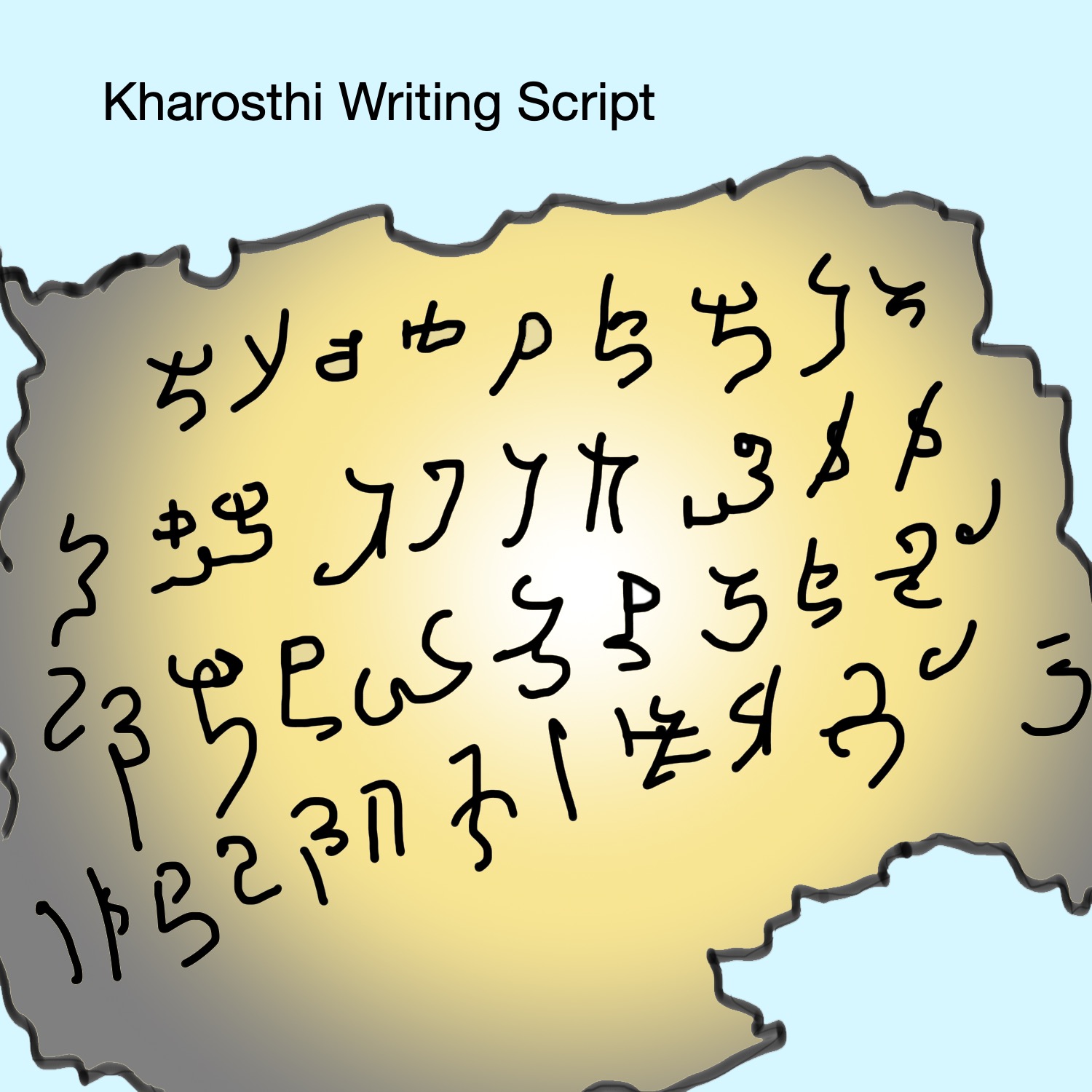
Kharosthi Writing Script. Picture by @wantwotwee.

The Kharosthi writing script is strongly influenced by the Aramaic script and, like most Semitic scripts, was written from right to left. Its use was limited to northwest India but it died out by the second century BCE.

Brahmi Writing Script. Picture by @wantwotwee.

The Brahmi script, on the other hand, had a much more influential impact to the development of writing in India. It is likely that the Brahmi script was also influenced or derived by some Semitic script because initially, the script was also written from right to left before the direction was later reversed and remained written from left to right for most of its history. The Brahmi script developed a structural design that is adopted and can be found in many modern Indian scripts such as Devanagari, Tamil, Thai and Tibetan. Some scholars estimate that upwards of 200 scripts are derived from the Brahmi script and they have been applied to languages from four different language families: Indo-Aryan, Dravidian, Sino-Tibetan and Austronesian. Geographically, the Brahmi-derived scripts can be found all over the Indian subcontinent, in South-East Asia and in Central Asia.

Structural Design of Brahmi-derived scripts

The two major design features that define a Brahmi-derived script are: (1) independent or initial vowel signs and (2) diacritic vowel indication in postconsonantal position.

One example of independent and initial vowel sign is /a-/ in alpha where /a-/ exists independently of the other preceding signs /l/, /p/, /h/, and /a/. Not all writing scripts provide this possibility as they may encode the initial vowel with the preceding consonantal sign or in the form of diacritics or other markers. The development of initial vowel sign is expected of the Brahmi script as it was used to write various Pakrits or Indo-Aryan dialects that had vowel-initial words and syllables consisting of only vowels. However, the majority of syllables are of the CV (Consonantal-Vowel) type. The CV-type syllable gives rise to the characteristic graphic syllable of Brahmi-derived scripts called the aksara. An aksara consists of one or more consonants followed by a vowel but the vowel is not encoded by an independent vowel sign as in /-a/ in alpha. Instead, the vowel is encoded by a diacritic sign called matra which is adjoined to the consonant sign.

Usually, there is a consonantal base that ‘inherits’ a vowel. This inherited vowel can be superseded by the use of another vowel diacritic on that consonant. The most frequently-used ‘inherited’ vowel is usually a reduced schwa or ‘a’, which is usually transliterated as ‘a’. Below is an example of Brahmi matras and how it re-interprets the aksara for the consonant letter k.

Brahmi's system of aksara & matra for /ka/. Picture by @wantwotwee.

As you can see, the initial consonantal base has an inherited /-a/. However, with the addition of diacritic markers, the /-a/ can be replaced with an /-e/, /-u/ or /-o/ just as easily.

In Brahmi, as well as in some other Brahmi-derived scripts such as Tamil where there are syllables of the CCV type in the language the script encodes, conjunct consonant signs may be used where one consonant sign takes a reduced form graphically in the conjunct consonant signs. This shall be discussed further later on.

Devanagari Script

Hindi-Devanagari Script. Picture by Ketut Subiyanto.

The Devanagari script is the major script of Sanskrit and other Indo-Aryan languages such as Hindi, Nepali, Sindhi, and Marathi.

Devanagari's system of aksara & matra for /ka/.
Picture by @wantwotwee.

The basic make-up of the Devanagari script is the system of aksara and matra. For example, the aksara for /ka/ which contains the inherent vowel /-a/ can be modified with a matra like /-i/ to form /ki/. As you may have noticed, the diacritic /-i/ is used before the consonant. Another example is the matra /-e/ that is written above the aksara and /-u/ which is written below the aksara. Thus, in order to read the Devanagari script, you must view the unit two dimensionally and as a whole rather than a succession of linear consonants and vowels.

Conjunct Consonant '-lpa' in Devanagari script. Picture by @wantwotwee.

Devanagari also utilises conjunct consonant signs where one consonant sign takes on a reduced form such as, in many cases, omitting the characteristic perpendicular stroke on the right hand side of the sign. For example, the word 'alpa' which means small in Hindi is transliterated as a+lpa but is pronounced as al+pa rather than a+lpa. In this example, we see that the consonant sign for /la/ and /pa/ has been fused to form the new conjunct sign /lpa/ where the perpendicular stroke of /la/ has been omitted and fused into the preceding consonant sign /pa/. The initial vowel /a-/, however, remains as an independent vowel sign.
Virama used in Devanagari script. Picture by @wantwotwee.

Another innovation of the Devanagari script is the diacritic called virama. Virama is a stroke slanting from left to right below an aksara and if used, has the effect of muting the inherent vowel in the consonant sign. For example, in the consonant sign /ka/, if /ka/ is used with the virama diacritic it has the effect of producing the velar stop sign /k/. Virama is used only in word final positions when the word itself is used in pause or followed by a punctuation mark.

Anusvara used in Devanagari script. Picture by @wantwotwee.

Another diacritic that modifies the aksara in the Devanagari script is the anusvara. Anusvara is a dot placed above the aksara and when used in the consonant, has the effect of nasalising the consonant. For example, the aksara /pa/ can be modified by an anuswara to form /pam/. In Sanskrit for example, it is also possible to replace the anusvara with a nasal conjunct /n/ as in [əŋɡə] which means 'limb of a body' which can be written as either अङ्ग or अंग. 
Visarga used in Devanagari script. Picture by @wantwotwee.

Finally, the diacritic visarga can also be used to modify the aksara. Visarga is a colon placed on the right side of the aksara and if used, has the effect of producing a final fricative or guttural /h/ and homorganic echo of the preceding vowel. For example, the consonant /bho/ can be modified by a visarga to form /bhoh/ which means 'sir' in Sanskrit.

To summarise this article on the Devanagari script, Devanagari uses aksara as its main functional unit. The unmarked aksara is interpreted to carry the inherent vowel /a/ or a weak schwa. Diacritics can be written on the aksara which will then replace the inherent vowel of the aksara. Additional diacritics can also be employed to indicate that the aksara is not to be interpreted as an open syllable as in the case of virama, anusvara, and visarga.

Devanagari Script (Hindi)

Credits: 
Pexels.
Writing Systems: An Introduction to their Linguistic Analysis by Florian Coulmas

Follow & Subscribe
Instagram: @wantwotwee
YouTube: Expirius Videos